Training a Neural Exchange-Correlation Functional
| Metadata | Value |
|---|---|
| Level | Advanced |
| Runtime | ~15 sec (GPU) / ~2 min (CPU) |
| Prerequisites | JAX, Flax NNX, DFT Basics |
| Format | Python + Jupyter |
| Memory | ~1 GB RAM |
Overview
This example demonstrates training a neural exchange-correlation (XC) functional from electron density data. The neural XC functional learns to predict exchange-correlation energies from electron density, going beyond traditional LDA/GGA approximations.
Key Concepts:
- Exchange-Correlation Energy: The challenging part of DFT
- Density Feature Extraction: Physics-informed input processing
- Attention Mechanism: Captures non-local electron correlations
- Physics Constraints: Ensures negative XC energy and proper scaling
What You'll Learn
- Generate synthetic training data with LDA reference energies
- Configure
NeuralXCFunctionalwith attention and advanced features - Train using MSE loss to match reference XC energies
- Evaluate accuracy with R² and correlation metrics
- Verify physics constraints (negative XC energy)
Coming from PyTorch/DeepChem?
| Traditional ML (PyTorch) | Opifex Neural XC |
|---|---|
| Generic MLP | Physics-informed architecture |
| Standard features | Density + gradients + kinetic energy |
| No physics constraints | Built-in negativity + scaling constraints |
torch.nn.Module |
NeuralXCFunctional |
model(x) |
model(density, gradients) |
Key differences:
- Physics-aware: Features include reduced gradient, Fermi wavevector
- Attention for non-locality: Captures beyond-local correlations
- Constrained output: Guarantees physically valid XC energy
- JAX-native: Automatic differentiation for functional derivatives
Files
- Python Script:
examples/quantum-chemistry/neural_xc_functional.py - Jupyter Notebook:
examples/quantum-chemistry/neural_xc_functional.ipynb
Quick Start
Run the Python Script
Run the Jupyter Notebook
Core Concepts
Exchange-Correlation Energy
In DFT, the XC energy captures: - Exchange: Pauli exclusion effects - Correlation: Electron-electron interactions beyond mean-field
The LDA approximation: $\(E_{xc}^{LDA} = -C_x \\int \\rho^{4/3} dr\)$
Neural XC functionals can learn more accurate energy predictions by: - Including gradient information (GGA-like) - Using attention for non-local correlations - Learning from high-level ab initio data
Neural XC Architecture
Feature Extractor computes: - Log density: log(ρ) - Gradient magnitude: |∇ρ| - Reduced gradient: |∇ρ| / ρ^(4/3) - Kinetic energy density - Fermi wavevector
Physics Constraints
The neural XC functional enforces: 1. Negative energy: XC energy should be attractive 2. Density scaling: Proper behavior at low densities 3. Numerical stability: Clipping and smoothing
Implementation
Step 1: Generate Training Data
def compute_lda_xc_energy(density):
    """Compute LDA exchange-correlation energy."""
    c_x = 0.738  # Exchange coefficient
    exchange = -c_x * jnp.power(density, 4/3)

    c_c = 0.044  # Correlation coefficient
    correlation = -c_c * density * jnp.log1p(density)

    return exchange + correlation

# Generate synthetic densities
train_densities = jnp.stack([
    generate_density_sample(key, grid_points)
    for key in train_keys
])
train_xc_ref = jnp.stack([
    compute_lda_xc_energy(d) for d in train_densities
])
Terminal Output:
Generating training data...
--------------------------------------------------
  Training samples: 500
  Test samples: 100
  Grid points per sample: 32

  Train densities shape: (500, 32)
  Train gradients shape: (500, 32, 3)
  Train XC reference shape: (500, 32)
Step 2: Create Neural XC Functional
from opifex.neural.quantum import NeuralXCFunctional
from flax import nnx

model = NeuralXCFunctional(
    hidden_sizes=(64, 64, 32),
    activation=nnx.gelu,
    use_attention=True,
    num_attention_heads=4,
    use_advanced_features=True,
    dropout_rate=0.0,
    rngs=nnx.Rngs(42),
)
Terminal Output:
Creating Neural XC Functional...
--------------------------------------------------
  Hidden sizes: (64, 64, 32)
  Use attention: True
  Attention heads: 4
  Use advanced features: True
  Total parameters: 23,303
Step 3: Train the Model
def loss_fn(model, densities, gradients, targets):
    predictions = model(densities, gradients, deterministic=True)
    return jnp.mean((predictions - targets) ** 2)

optimizer = nnx.Optimizer(model, optax.adam(1e-3), wrt=nnx.Param)

@nnx.jit
def train_step(model, optimizer, densities, gradients, targets):
    loss, grads = nnx.value_and_grad(loss_fn)(model, densities, gradients, targets)
    optimizer.update(model, grads)
    return loss
Terminal Output:
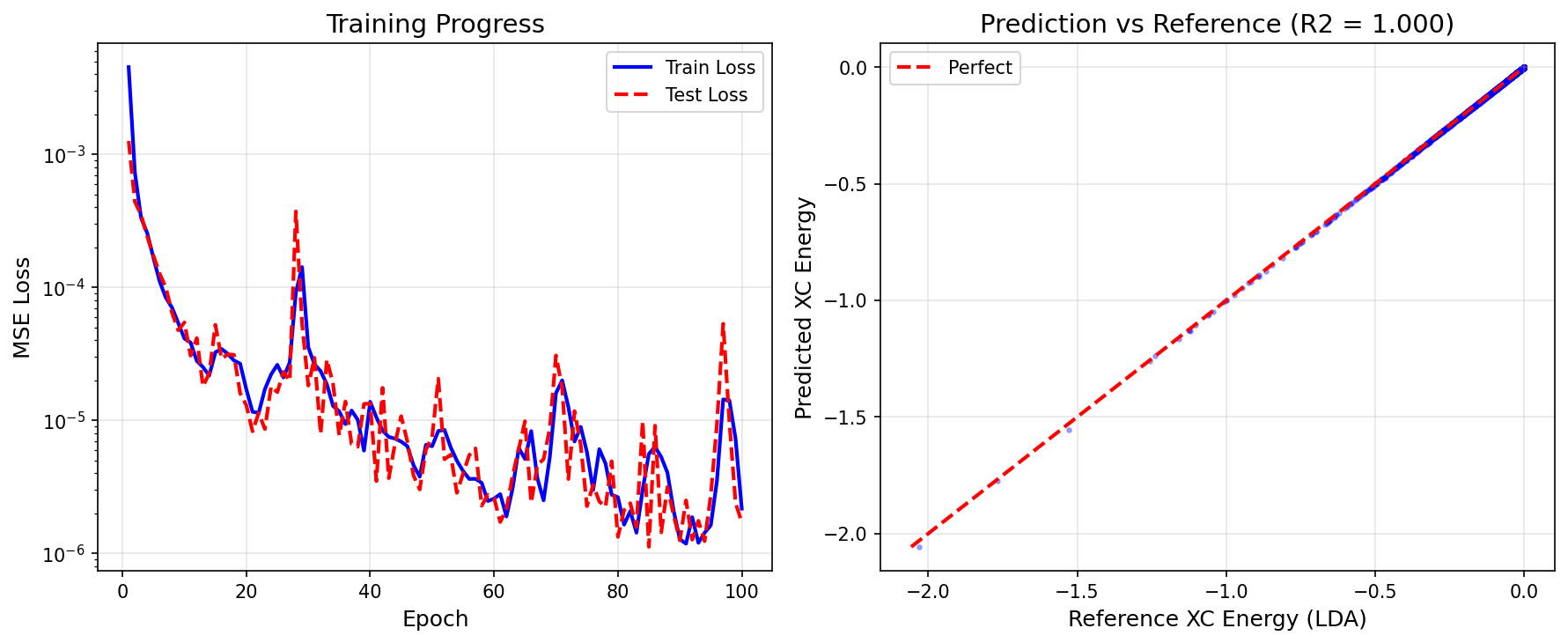
Training Neural XC Functional...
--------------------------------------------------
  Epoch   1/100: train_loss = 0.004533, test_loss = 0.001263
  Epoch  10/100: train_loss = 0.000041, test_loss = 0.000054
  Epoch  20/100: train_loss = 0.000017, test_loss = 0.000013
  Epoch  50/100: train_loss = 0.000006, test_loss = 0.000008
  Epoch 100/100: train_loss = 0.000002, test_loss = 0.000002

Training complete!
  Training time: 10.3s
  Final train loss: 0.000002
  Final test loss: 0.000002
Step 4: Evaluate Performance
test_predictions = model(test_densities, test_gradients, deterministic=True)

mse = jnp.mean((test_predictions - test_xc_ref) ** 2)
r2 = 1 - jnp.sum((test_xc_ref - test_predictions) ** 2) / \
         jnp.sum((test_xc_ref - jnp.mean(test_xc_ref)) ** 2)
Terminal Output:
Evaluating model performance...
--------------------------------------------------
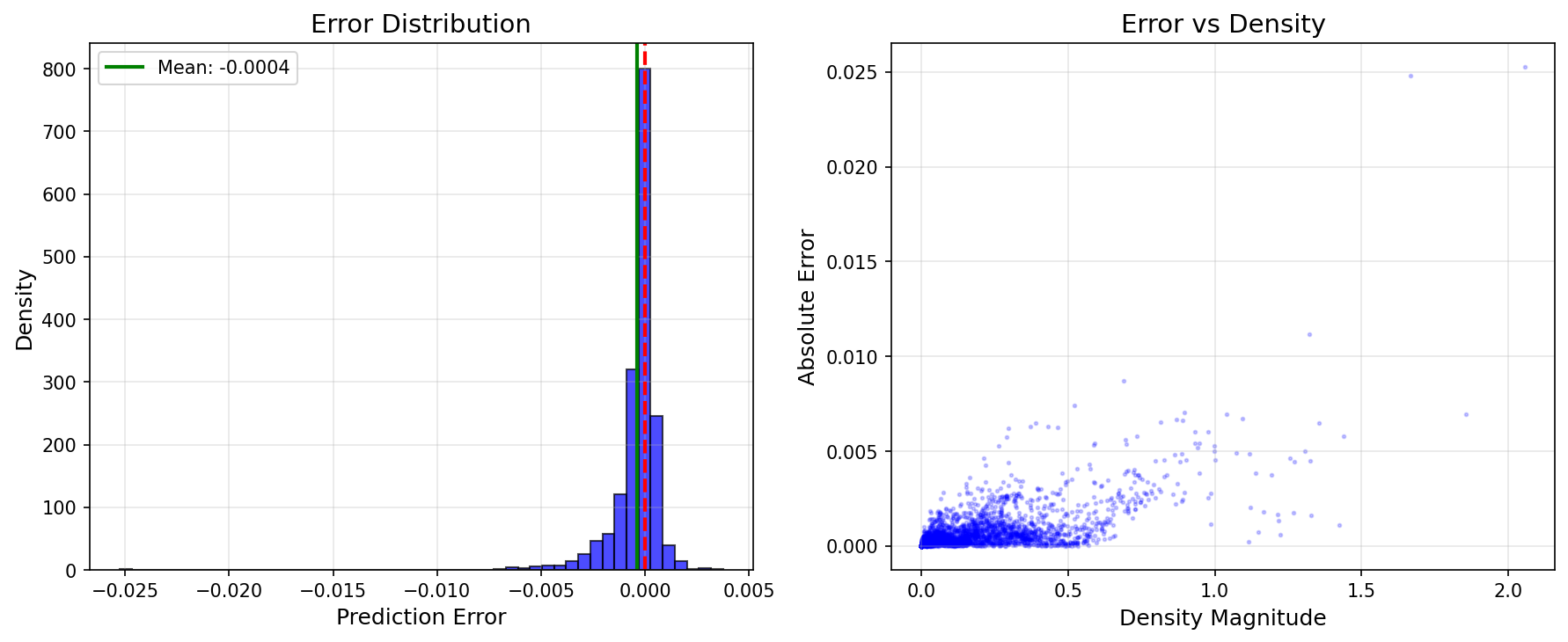
  Mean Squared Error (MSE): 1.703340e-06
  Mean Absolute Error (MAE): 6.605385e-04
  R-squared (R2): 0.9999
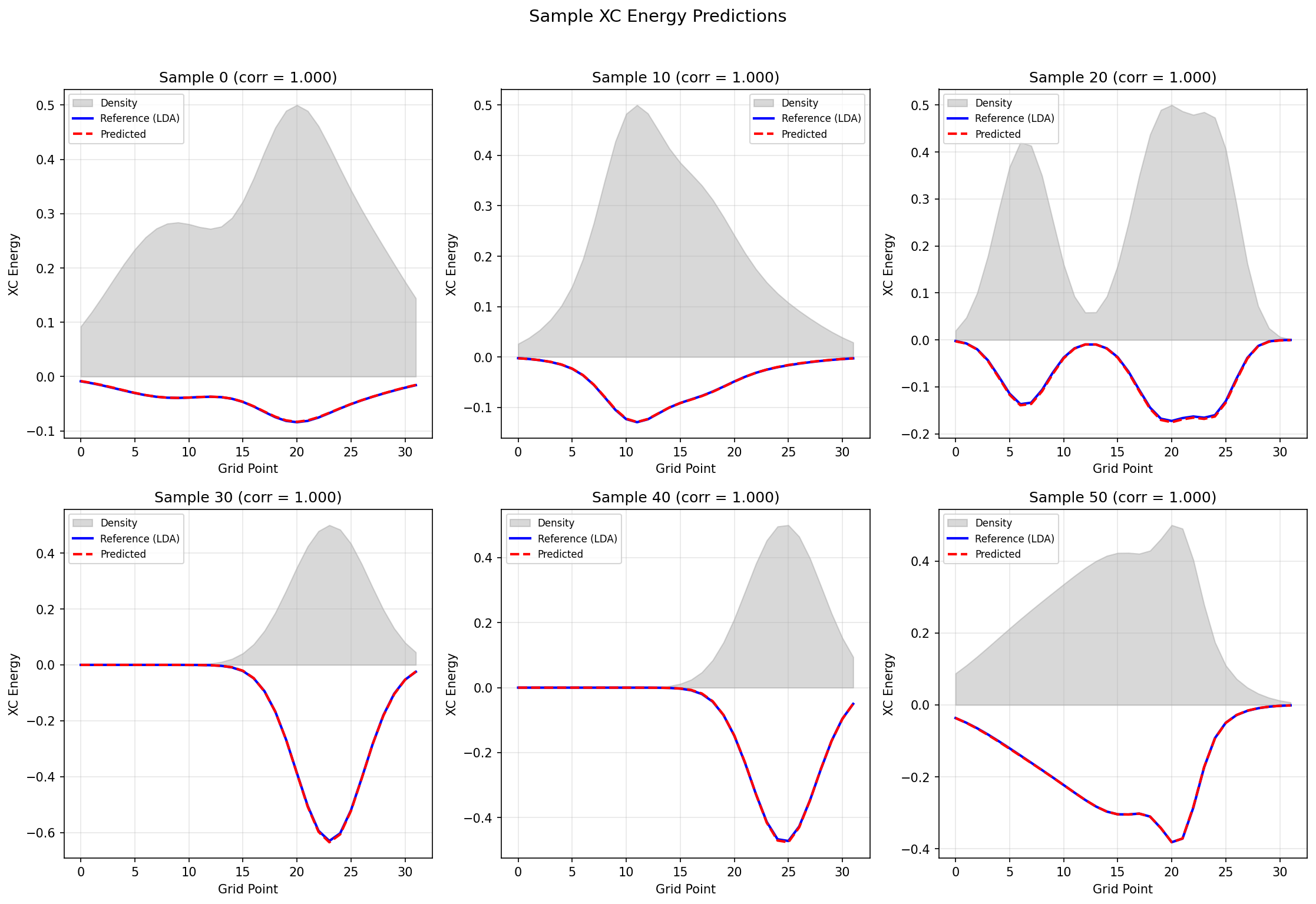
  Mean Correlation: 1.0000

Physics Constraint Verification:
  XC energy negative: 100.0% of predictions
Visualization
Results Summary
| Metric | Value |
|---|---|
| Hidden sizes | (64, 64, 32) |
| Attention heads | 4 |
| Parameters | 23,303 |
| Training samples | 500 |
| Training time | ~10s |
| Final MSE | 1.70e-6 |
| R-squared | 0.9999 |
| Mean correlation | 1.0000 |
| Negative XC energy | 100% |
Next Steps
Experiments to Try
- More hidden layers: Try (128, 128, 64, 32) for complex patterns
- More attention heads: 8 heads may capture finer correlations
- Disable attention: Compare with/without for local vs non-local effects
- Real DFT data: Train on reference data from PySCF or Gaussian
Related Examples
| Example | Level | What You'll Learn |
|---|---|---|
| Neural DFT | Advanced | Full DFT energy calculation |
| FNO on Darcy | Beginner | Data-driven operator learning |
API Reference
NeuralXCFunctional: Main neural XC functional classDensityFeatureExtractor: Physics-informed feature extractionMultiHeadAttention: Attention for non-local correlationscompute_functional_derivative(): Compute XC potential V_xcassess_chemical_accuracy(): Built-in accuracy assessment
Troubleshooting
| Issue | Solution |
|---|---|
| NaN in training | Reduce learning rate, check density range |
| Poor R² | More training data, larger model |
| Positive XC energy | Check physics constraints are enabled |
| Slow training | Use GPU, reduce batch size |
Advanced Usage
Computing the XC Potential:
# Functional derivative for Kohn-Sham equations
xc_potential = model.compute_functional_derivative(
    density, gradients, deterministic=True
)
Driving the Kohn-Sham SCF with the learned functional: