Wave Equation PINN
| Metadata | Value |
|---|---|
| Level | Intermediate |
| Runtime | ~3 min (GPU) / ~12 min (CPU) |
| Prerequisites | JAX, Flax NNX, basic calculus |
| Format | Python + Jupyter |
| Memory | ~500 MB RAM |
Overview
This tutorial demonstrates solving the 1D wave equation using a Physics-Informed Neural Network (PINN). The wave equation describes the propagation of waves in strings, acoustics, and electromagnetic fields.
The wave equation is a hyperbolic PDE that presents unique challenges for PINNs: the solution propagates information along characteristic lines, and sharp wave fronts can be difficult to capture. This example uses a standing wave solution which is more amenable to neural network approximation.
What You'll Learn
- Implement a PINN for second-order hyperbolic PDEs
- Enforce initial position AND initial velocity conditions
- Compute second-order time derivatives using JAX Hessian
- Validate against analytical standing wave solution
- Visualize spatiotemporal wave propagation
Coming from DeepXDE?
If you are familiar with the DeepXDE library:
| DeepXDE | Opifex (JAX) |
|---|---|
dde.geometry.Interval(0, 1) |
jax.random.uniform(key, (N,), minval=0, maxval=1) |
dde.geometry.GeometryXTime(geom, timedomain) |
jnp.column_stack([x, t]) for (x, t) |
dde.grad.hessian(y, x, i=1, j=1) |
jax.hessian(u_fn)(xt)[1, 1] for u_tt |
dde.icbc.IC(geom, func, on_initial) |
Manual t=0 sampling + loss term |
dde.icbc.OperatorBC(geom, du_dt, on_initial) |
jax.grad(u_fn)(xt)[1] for velocity condition |
model.compile("adam", lr=1e-3) |
nnx.Optimizer(pinn, optax.adam(lr), wrt=nnx.Param) |
Key differences:
- Unified initial conditions: Both position and velocity ICs handled as loss terms
- Pure JAX autodiff: Use
jax.hessianfor second derivatives directly - No special networks: Standard MLP works for standing waves (DeepXDE uses STMsFFN)
- No resampling: Fixed collocation points (add resampling for traveling waves)
Files
- Python Script:
examples/pinns/wave.py - Jupyter Notebook:
examples/pinns/wave.ipynb
Quick Start
Run the Python Script
Run the Jupyter Notebook
Core Concepts
Wave Equation
The 1D wave equation is a hyperbolic PDE:
| Component | This Example |
|---|---|
| Domain | \(x \in [0, 1]\), \(t \in [0, 1]\) |
| Wave speed | \(c = 1\) |
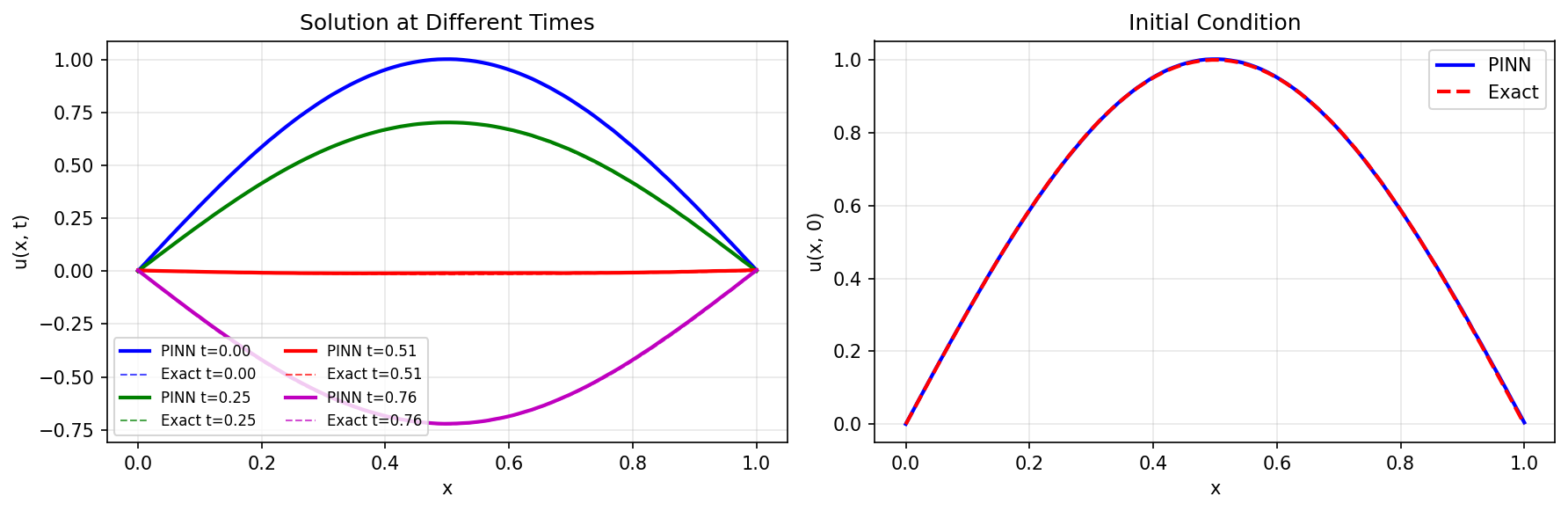
| Initial position | \(u(x, 0) = \sin(\pi x)\) |
| Initial velocity | \(\frac{\partial u}{\partial t}(x, 0) = 0\) |
| Boundary conditions | \(u(0, t) = u(1, t) = 0\) (fixed ends) |
| Analytical solution | \(u(x, t) = \sin(\pi x) \cos(c\pi t)\) |
Physical Interpretation
- Standing wave: The initial condition \(\sin(\pi x)\) with zero velocity creates a standing wave
- Fixed boundaries: String endpoints are held fixed (Dirichlet conditions)
- Oscillation: The solution oscillates in time with frequency \(c\pi\)
PINN Loss Components
graph TB
    subgraph Input["Collocation Points"]
        A["Domain Points<br/>(x, t) in Ω"]
        B["Boundary Points<br/>x=0, x=1"]
        C["Initial Points<br/>t=0"]
    end

    subgraph PINN["Neural Network u_θ(x, t)"]
        D["Linear + tanh<br/>50 units"]
        E["Linear + tanh<br/>50 units"]
        F["Linear + tanh<br/>50 units"]
        G["Linear<br/>1 unit"]
    end

    subgraph Loss["Physics-Informed Loss"]
        H["PDE Residual<br/>|u_tt - c²u_xx|²"]
        I["BC Loss<br/>|u(0,t)|² + |u(1,t)|²"]
        J["IC Position<br/>|u(x,0) - sin(πx)|²"]
        K["IC Velocity<br/>|u_t(x,0)|²"]
        L["Total Loss"]
    end

    A --> D --> E --> F --> G --> H
    B --> D
    C --> D
    G --> I
    G --> J
    G --> K
    H --> L
    I --> L
    J --> L
    K --> L

    style H fill:#e3f2fd,stroke:#1976d2
    style I fill:#fff3e0,stroke:#f57c00
    style J fill:#e8f5e9,stroke:#388e3c
    style K fill:#fce4ec,stroke:#c2185b
style L fill:#f3e5f5,stroke:#7b1fa2Implementation
Step 1: Imports and Configuration
Terminal Output:
======================================================================
Opifex Example: Wave Equation PINN
======================================================================
JAX backend: gpu
JAX devices: [CudaDevice(id=0)]
Wave speed: c = 1.0
Domain: x in [0.0, 1.0], t in [0.0, 1.0]
Collocation: 2000 domain, 200 boundary, 200 initial
Network: [2] + [50, 50, 50] + [1]
Training: 15000 epochs @ lr=0.001
Step 2: Define the Problem
C = 1.0  # Wave speed

def exact_solution(x, t):
    return jnp.sin(jnp.pi * x) * jnp.cos(C * jnp.pi * t)

def initial_condition(x):
    return jnp.sin(jnp.pi * x)
Terminal Output:
Wave equation: u_tt = c^2 * u_xx
Initial condition: u(x, 0) = sin(pi*x)
Initial velocity: u_t(x, 0) = 0
Boundary conditions: u(0, t) = u(1, t) = 0
Analytical solution: u(x, t) = sin(pi*x) * cos(c*pi*t)
Step 3: Create the PINN
class WavePINN(nnx.Module):
    def __init__(self, hidden_dims: list[int], *, rngs: nnx.Rngs):
        layers = []
        in_features = 2  # (x, t)

        for hidden_dim in hidden_dims:
            layers.append(nnx.Linear(in_features, hidden_dim, rngs=rngs))
            in_features = hidden_dim

        layers.append(nnx.Linear(in_features, 1, rngs=rngs))
        self.layers = nnx.List(layers)

    def __call__(self, xt):
        h = xt
        for layer in self.layers[:-1]:
            h = jnp.tanh(layer(h))
        return self.layers[-1](h)

pinn = WavePINN(hidden_dims=[50, 50, 50], rngs=nnx.Rngs(42))
Terminal Output:
Step 4: Compute PDE Residual
def compute_pde_residual(pinn, xt):
    def u_scalar(xt_single):
        return pinn(xt_single.reshape(1, 2)).squeeze()

    def residual_single(xt_single):
        hess = jax.hessian(u_scalar)(xt_single)
        u_xx = hess[0, 0]  # d^2u/dx^2
        u_tt = hess[1, 1]  # d^2u/dt^2
        return u_tt - C**2 * u_xx

    return jax.vmap(residual_single)(xt)
Step 5: Training
Terminal Output:
Training PINN...
  Epoch     1/15000: loss=4.347104e+00
  Epoch  3000/15000: loss=1.659206e-03
  Epoch  6000/15000: loss=1.217277e-03
  Epoch  9000/15000: loss=8.646434e-04
  Epoch 12000/15000: loss=3.246390e-04
  Epoch 15000/15000: loss=9.056964e-04
Final loss: 9.056964e-04
Step 6: Evaluation
Terminal Output:
Evaluating PINN...
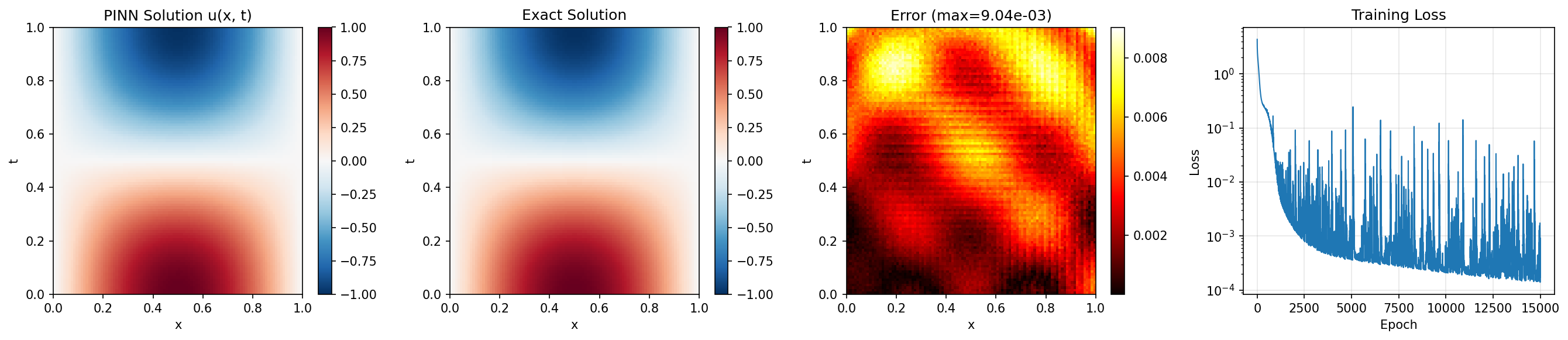
Relative L2 error:   8.166147e-03
Maximum point error: 9.041926e-03
Mean point error:    3.580939e-03
Mean PDE residual:   7.680781e-03
Visualization
Solution Comparison
Time Snapshots
Results Summary
| Metric | Value |
|---|---|
| Final Loss | 9.06e-04 |
| Relative L2 Error | 0.82% |
| Maximum Point Error | 9.04e-03 |
| Mean Point Error | 3.58e-03 |
| Mean PDE Residual | 7.68e-03 |
| Parameters | 5,301 |
| Training Epochs | 15,000 |
Next Steps
Experiments to Try
- Higher wave speed: Try \(c = 2\) or \(c = 5\) (faster oscillations)
- Traveling wave: Change IC to \(u(x, 0) = e^{-(x-0.5)^2/0.01}\) Gaussian pulse
- Longer time: Extend \(t_{max}\) to observe multiple oscillations
- More modes: Try IC \(u(x,0) = \sin(\pi x) + 0.5\sin(2\pi x)\) for superposition
- Damped wave: Add damping term \(-\gamma u_t\) to the PDE
Related Examples
| Example | Level | What You'll Learn |
|---|---|---|
| Heat Equation | Intermediate | Parabolic PDE (diffusion) |
| Burgers Equation | Intermediate | Nonlinear hyperbolic PDE |
| Poisson Equation | Intermediate | Elliptic PDE (steady-state) |
| Helmholtz Equation | Advanced | Wave equation in frequency domain |
API Reference
nnx.Linear- Linear layernnx.Optimizer- Optimizer wrapperjax.hessian- Hessian computationjax.vmap- Vectorized mapping
Troubleshooting
Solution doesn't oscillate
Symptom: PINN solution decays to zero instead of oscillating.
Cause: Initial velocity condition not enforced strongly enough.
Solution: Increase the weight on the initial velocity loss:
def total_loss(pinn, xt_dom, xt_bc, xt_ic, u_ic, lambda_ic=20.0):
    loss_pde = pde_loss(pinn, xt_dom)
    loss_bc = boundary_loss(pinn, xt_bc)
    loss_ic = initial_loss(pinn, xt_ic, u_ic)
    loss_vel = initial_velocity_loss(pinn, xt_ic)
    return loss_pde + 10 * loss_bc + lambda_ic * (loss_ic + 2.0 * loss_vel)
High error at later times
Symptom: Error grows as \(t\) increases.
Cause: Wave propagation is poorly captured far from initial conditions.
Solution: Use more collocation points or time-stratified sampling:
# Stratify points uniformly across time
t_domain = jnp.linspace(T_MIN, T_MAX, N_DOMAIN)
x_domain = jax.random.uniform(key, (N_DOMAIN,), minval=X_MIN, maxval=X_MAX)
Loss doesn't decrease
Symptom: Training loss stays constant or oscillates.
Cause: Network unable to satisfy competing constraints simultaneously.
Solution: Use adaptive loss weighting:
# Adjust weights based on individual loss magnitudes
loss_pde_val = pde_loss(pinn, xt_domain)
loss_bc_val = boundary_loss(pinn, xt_boundary)
loss_ic_val = initial_loss(pinn, xt_initial, u_initial)

# Normalize to similar magnitudes
weight_bc = loss_pde_val / (loss_bc_val + 1e-8)
weight_ic = loss_pde_val / (loss_ic_val + 1e-8)
Spectral bias issues
Symptom: Network captures low-frequency modes but misses high-frequency details.
Cause: Neural networks naturally favor low-frequency solutions (spectral bias).
Solution: Use Fourier feature encoding: