Equivariant DFT Hamiltonian Prediction (QHNet block form)
| Metadata | Value |
|---|---|
| Level | Advanced |
| Runtime | ~1 min (GPU) |
| Prerequisites | JAX, Flax NNX, SE(3)-equivariant networks, DFT/Hartree-Fock |
| Format | Python + Jupyter |
| Memory | ~2 GB RAM |
Overview
This example predicts the dense atomic-orbital DFT/Hartree-Fock Hamiltonian
(Fock) matrix H of a molecule directly from its geometry, with the
QHNet-style BlockHamiltonianPredictor (Yu et al. 2023,
arXiv:2306.04922). Rather than assembling one
dense matrix per fixed composition, the predictor emits a fixed (14, 14) block
per atom (the on-site diagonal Fock block) and per directed edge (the off-site
off-diagonal block) in the def2-SVP irrep layout
BLOCK_IRREPS = 3x0e + 2x1e + 1x2e. Because the blocks are fixed-size and the
NequIP convolution scatters messages only over within-molecule edges, any
concatenation of heterogeneous molecules runs through one compiled forward — the
property that makes batched QH9 training tractable.
The predicted blocks are SE(3)-equivariant by construction — rotating the
molecule rotates each block by the real Wigner-D matrix D_14(R) of
BLOCK_IRREPS, and the assembled dense matrix therefore obeys
H(R x) = D(R) H(x) D(R)^T. No ground-truth fit is needed to demonstrate the
structure: this example is a thin, untrained demo of the block mechanics.
The example is deliberately thin — it composes opifex's committed electronic-structure stack and changes no library internals:
BlockHamiltonianPredictor(QHNet block form) is the heterogeneous-batchable predictor: a NequIP steerable trunk feeds a sharedHamiltonianBlockExpansionhead that emits the(14, 14)diagonal (per atom) and off-diagonal (per edge) blocks.assemble_matrixmasks each block to its element's valid AO slots (block_validity_mask), scatters it to the per-atom AO offsets, and symmetrizesH = H~ + H~^Tinto the dense Fock.wigner_dassembles the block-diagonal AO rotation for the equivariance check.
What You'll Learn
- Build the heterogeneous-batchable
BlockHamiltonianPredictorfrom the library - Run it on a concatenated batch of two different molecules and read the per-atom / per-edge blocks
- Confirm the flat batch reproduces the per-molecule blocks (the segment design)
- Assemble a single molecule's symmetric dense Fock with
assemble_matrix - Verify the assembled-matrix equivariance
H(R x) = D(R) H(x) D(R)^T - Visualize the assembled Fock heatmap and the per-rotation equivariance error
Background: the DFT Hamiltonian as an equivariant operator
Mean-field electronic structure (Hartree-Fock or Kohn-Sham DFT) solves the
generalised eigenvalue problem H C = S C eps in an atomic-orbital basis, where
H is the Fock/Kohn-Sham matrix, S the AO overlap, C the molecular-orbital
coefficients, and eps the orbital energies. The bottleneck is the
self-consistent-field iteration that converges H; predicting the converged H
in one shot skips it.
H and S are not invariant — they are equivariant operators. Each AO has a
definite angular momentum l, so a rigid rotation R of the molecule rotates the
AO components by the Wigner-D matrix D^l(R) of their shell. The whole matrix
therefore transforms as H(R x) = D(R) H(x) D(R)^T, with D(R) block-diagonal
over shells. A model that bakes this law in needs far less data and never has to
learn the symmetry from examples.
opifex builds the predictor from the native equivariant kit in
opifex.neural.equivariant (irreps, Clebsch-Gordan tensor products, spherical
harmonics, Bessel radial bases) and the NequIP steerable trunk. See
Hamiltonian Prediction for the
block-assembly design.
Building the predictor
BlockHamiltonianPredictor carries steerable hidden features up to l = 2 (so
the trunk can represent every degree the s/p/d blocks reach: 0e, 1e,
2e), two NequIP convolution layers, an 8-function Bessel radial basis, and a
generous cutoff so the small molecules form a complete within-molecule graph. No
weights are trained — the equivariance is structural and holds for any weights:
from flax import nnx
from opifex.neural.quantum.hamiltonian import (
    BlockHamiltonianConfig, BlockHamiltonianPredictor,
)

predictor = BlockHamiltonianPredictor(
    config=BlockHamiltonianConfig(
        hidden_irreps="32x0e + 16x1o + 8x2e",
        sh_lmax=2,
        num_interactions=2,
        num_radial_basis=8,
        cutoff=20.0,           # Bohr; large enough that the molecule is a complete graph
    ),
    rngs=nnx.Rngs(0),
)
Running a heterogeneous batch
The predictor consumes a flat concatenated batch: (A,) atomic numbers, (A, 3)
positions (Bohr) and a (2, E) within-molecule directed (senders, receivers)
edge index, offset per molecule so edges never cross boundaries. Water (O, H, H)
and a methane-like (C, H, H, H, H) fragment concatenate into one batch:
batch_out = predictor(batch_atomic_numbers, batch_positions, batch_edge_index)
# batch_out["diagonal_blocks"]:     (8, 14, 14)  — one block per atom
# batch_out["off_diagonal_blocks"]: (26, 14, 14) — one block per directed edge
The segment design must give exactly the per-molecule blocks when the molecules
are run alone — the flat-batch blocks match the per-molecule blocks to float
round-off (<= 6e-17), so concatenation leaks no information across molecule
boundaries.
Assembling the dense Fock
assemble_matrix masks each (14, 14) block to its element's valid AO slots
(hydrogen keeps 2s + 1p, C/N/O/F all 14), scatters it to the per-atom AO
offsets, writes off-diagonal blocks at both (i, j) and (j, i), and symmetrizes
H = H~ + H~^T. Water (O 14 + H 5 + H 5) gives a symmetric (24, 24)
matrix:
matrix = predictor.assemble_matrix(
    water_out["diagonal_blocks"], water_out["off_diagonal_blocks"],
    water_atomic_numbers, water_edge_index,
)   # (24, 24), max |H - H^T| = 0
Equivariance check
The defining property: under a random proper rotation R the assembled dense
matrix transforms as H(R x) = D(R) H(x) D(R)^T, where D(R) is block-diagonal
over atoms — each atom's block is the (14, 14) Wigner-D D_14(R) of
BLOCK_IRREPS restricted to that atom's populated AO slots (whole shells, so the
restriction is exact):
import jax
from opifex.geometry.algebra.wigner import wigner_d

def block_wigner(rotation):
    matrices = []
    for mul, irrep in BLOCK_IRREPS.blocks:
        matrices.extend([wigner_d(irrep.l, rotation)] * mul)
    return jax.scipy.linalg.block_diag(*matrices)
The full AO rotation restricts block_wigner to each atom's valid slots and
stacks them block-diagonally. This holds for any weights, so the untrained
predictor already satisfies it to matmul precision.
Results
A single GPU run of this example (untrained predictor, float64, ~30 s on one
RTX 4090). The block mechanics are exact up to floating-point round-off.
| Quantity | Value |
|---|---|
Diagonal-block asymmetry (forward D + D^T) |
0.00e+00 |
| Flat-batch vs per-molecule diagonal blocks | 5.55e-17 |
| Flat-batch vs per-molecule off-diagonal blocks | 6.94e-18 |
Assembled water Fock symmetry max \|H - H^T\| |
0.00e+00 |
The flat heterogeneous batch reproduces the per-molecule blocks to floating-point
round-off, and the assembled (24, 24) Fock is exactly symmetric.
Assembled-matrix SE(3) equivariance
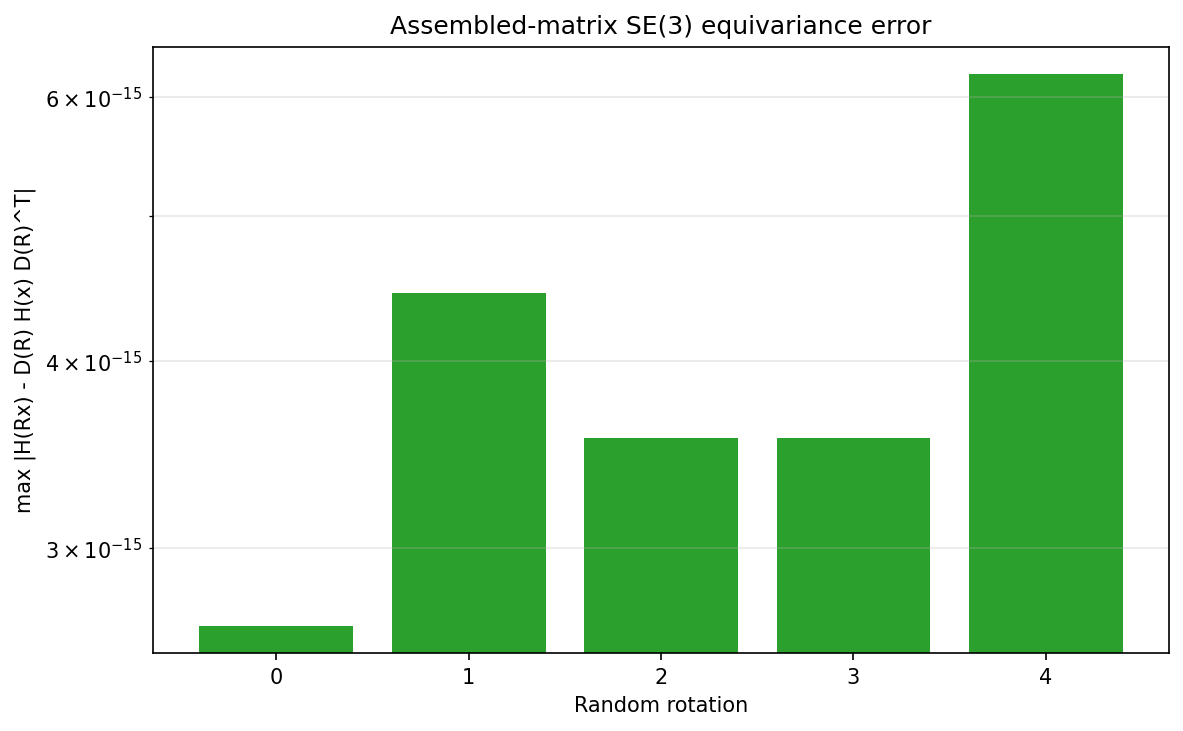
Across five random rotations the worst-case residual
max |H(R x) - D(R) H(x) D(R)^T| is 5.55e-16 — at float64 precision,
confirming the equivariance is exact up to numerical round-off and holds for the
untrained weights:
| Random rotation | 0 | 1 | 2 | 3 | 4 |
|---|---|---|---|---|---|
| Equivariance error | 2.22e-16 | 3.33e-16 | 3.33e-16 | 3.33e-16 | 5.55e-16 |
Assembled Fock matrix
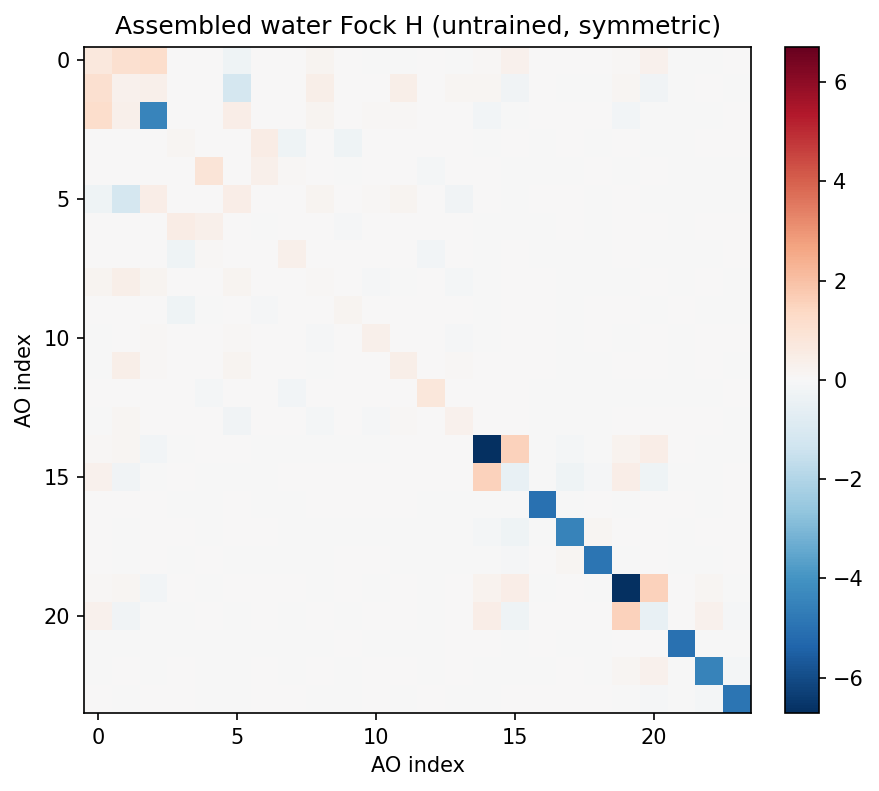
The assembled matrix is exactly symmetric; the masked hydrogen blocks (2s + 1p)
appear as the smaller diagonal sub-blocks beside the full 14-slot oxygen block.
Equivariance error per rotation
Training against QH9
This example shows the block mechanics with an untrained predictor. To train the predictor against the QH9 benchmark — the converged B3LYP/def2-SVP Fock matrices for the QM9 molecules — run:
It streams QH9-Stable through the block-form data pipeline
(opifex.data.sources.qh9_blocks / qh9_block_stream), cuts each Fock matrix
into the per-atom / per-edge blocks the predictor emits, and minimises the masked
block loss (qh9_block_loss, make_block_train_step).
Running the example
No external download is required (the molecules are defined inline).
Key takeaways
- The block-form predictor is a thin composition of the opifex
electronic-structure stack: predictor → flat batch → per-atom/per-edge blocks →
assemble_matrix. - Heterogeneous molecules concatenate into one compiled forward — the
fixed-size
(14, 14)blocks and within-molecule edge scatter mean any batch of mixed compositions runs without per-composition recompile, and the batch blocks reproduce the per-molecule blocks exactly. - Equivariance is structural, not learned —
H(R x) = D(R) H(x) D(R)^Tholds to matmul precision for any weights, because each block is a Clebsch-Gordan (Wigner-Eckart) contraction of a steerable feature and the matrix is symmetrizedH = H~ + H~^T. - The block form is the QH9 training target —
scripts/train_qh9_blocks.pyfits the predictor to the def2-SVP Fock benchmark through the block-form data pipeline and masked block loss.
See also
- Hamiltonian Prediction — the
block-assembly design (
HamiltonianBlockExpansion, per-atom/per-edge blocks, masking, symmetrization), trunk reuse, QH9 training, and how to extend (overlapS, QHNetV2 SO(2) frame). - Atomistic Potentials — the NequIP steerable trunk the predictor reuses.
- Yu et al. 2023, Efficient and Equivariant Graph Networks for Predicting Quantum Hamiltonian (QHNet), ICML 2023 (arXiv:2306.04922).
- Yu et al. 2025, QHNetV2: A Fully Equivariant Network for Quantum Hamiltonian Prediction (arXiv:2506.09398).
- Unke et al. 2021, SE(3)-equivariant prediction of molecular wavefunctions and electronic densities (PhiSNet), NeurIPS 2021 (arXiv:2106.02347).
- Yu et al. 2023, QH9: A Quantum Hamiltonian Prediction Benchmark for QM9 Molecules, NeurIPS 2023 (arXiv:2306.09549).