DeepONet on Darcy Flow
| Metadata | Value |
|---|---|
| Level | Intermediate |
| Runtime | ~2 min (CPU) / ~20s (GPU) |
| Prerequisites | JAX, Flax NNX, Neural Operators basics |
| Format | Python + Jupyter |
| Memory | ~1 GB RAM |
Overview
Train a Deep Operator Network (DeepONet) to learn the Darcy flow operator, which maps permeability coefficient fields to pressure solutions. Unlike FNO which operates on grids, DeepONet uses a branch-trunk architecture that is resolution-independent -- once trained, it can be queried at arbitrary spatial locations.
This example applies the standard operator-learning recipe -- ~1000 training samples, Gaussian input/output normalization, and the relative-L2 objective -- to drive the test relative L2 error to ~0.096.
What You'll Learn
- Reshape grid data into DeepONet's branch/trunk format
- Normalize inputs and targets with training-set Gaussian statistics
- Create a
DeepONetwith branch and trunk networks - Train with a custom loop using
nnx.Optimizerand the relative-L2 loss - Evaluate predictions and analyze learned representations
Coming from NeuralOperator (PyTorch)?
If you are familiar with the neuraloperator library's DeepONet implementation:
| NeuralOperator (PyTorch) | Opifex (JAX) |
|---|---|
DeepONet(branch_net, trunk_net) |
DeepONet(branch_sizes, trunk_sizes, rngs=...) |
model(u, y) |
model(branch_input, trunk_input) |
torch.optim.Adam |
nnx.Optimizer(model, optax.adam(schedule), wrt=nnx.Param) |
Manual loss.backward() |
nnx.value_and_grad(loss_fn)(model) |
Key differences:
- Flax NNX modules: Explicit PRNG, functional transforms
- XLA compilation: Use
@nnx.jitinstead oftorch.compile - Integrated layer sizes: Pass
[input, hidden..., output]lists directly - Training options: Custom loop with
nnx.Optimizer, or wrap withDeepONetTrainerAdapterforBasicTrainercompatibility
Files
- Python Script:
examples/neural-operators/deeponet_darcy.py - Jupyter Notebook:
examples/neural-operators/deeponet_darcy.ipynb
Quick Start
Run the Python Script
Run the Jupyter Notebook
Core Concepts
DeepONet Architecture
DeepONet learns nonlinear operators \(G: u \to G(u)\) mapping between function spaces:
where:
- Branch network \(b_k\): Encodes the input function \(u\) evaluated at \(m\) sensor locations
- Trunk network \(t_k\): Encodes the evaluation location \(y\)
- Output: Dot product of \(p\)-dimensional branch and trunk embeddings
graph LR
    subgraph Input
        A["Permeability Field<br/>u(x) : (1024,)"]
    end

    subgraph DeepONet["Deep Operator Network"]
        B["Branch Net<br/>MLP: 1024→256→256→128"]
        C["Trunk Net<br/>MLP: 2→128→128→128→128"]
        D["Dot Product<br/>Σ bₖ · tₖ"]
    end

    subgraph Output
        E["Pressure Field<br/>G(u)(y) : (1024,)"]
    end

    A --> B
    F["Query Locations<br/>y : (1024, 2)"] --> C
    B --> D
    C --> D
    D --> E

    style A fill:#e3f2fd,stroke:#1976d2
    style E fill:#c8e6c9,stroke:#388e3c
FNO vs DeepONet
| Aspect | FNO | DeepONet |
|---|---|---|
| Grid structure | Fixed resolution required | Arbitrary point evaluation |
| Data efficiency | Better for grid problems | Requires more data typically |
| Resolution | Tied to training resolution | Resolution-independent |
| Architecture | Spectral convolutions | Branch-trunk MLP decomposition |
Implementation
Step 1: Imports and Setup
import jax
import jax.numpy as jnp
import numpy as np
from flax import nnx
import optax

from opifex.data.loaders import create_darcy_loader
from opifex.neural.operators.deeponet import DeepONet
Terminal Output:
JAX backend: gpu
JAX devices: [CudaDevice(id=0)]
Resolution: 32x32
Training samples: 1000, Test samples: 100
Sensors: 1024, Latent dim: 128
Step 2: Data Preparation and Normalization
DeepONet requires reshaping grid data into sensor values and coordinate queries.
create_darcy_loader returns a frozen PDELoaders whose .train/.val
datarax pipelines yield channels-first dicts with "input"/"output" of shape
(b, 1, res, res); we collect both splits and drop the channel axis. We then
fit Gaussian statistics on the training split and standardize the branch input
and the target -- the standard operator-learning normalization:
n_samples = N_TRAIN + N_TEST
loaders = create_darcy_loader(
    n_samples=n_samples,
    batch_size=BATCH_SIZE,
    resolution=RESOLUTION,
    val_fraction=N_TEST / n_samples,
    seed=SEED,
)


def _collect(pipeline) -> tuple[np.ndarray, np.ndarray]:
    inputs, outputs = [], []
    for batch in pipeline:
        inputs.append(np.asarray(batch["input"]))
        outputs.append(np.asarray(batch["output"]))
    return np.concatenate(inputs, axis=0), np.concatenate(outputs, axis=0)


X_train_grid, Y_train_grid = _collect(loaders.train)  # (N, 1, res, res)
X_test_grid, Y_test_grid = _collect(loaders.val)  # (N, 1, res, res)

# Drop the channel axis so the viz/grid views are (N, res, res).
X_train_grid = X_train_grid[:, 0]
Y_train_grid = Y_train_grid[:, 0]
X_test_grid = X_test_grid[:, 0]
Y_test_grid = Y_test_grid[:, 0]

# Flatten grid to sensor values for branch input
X_train_branch = X_train_grid.reshape(X_train_grid.shape[0], -1)  # (1024, 1024)

# Create coordinate grid for trunk input
x_coords = np.linspace(0, 1, RESOLUTION)
y_coords = np.linspace(0, 1, RESOLUTION)
xx, yy = np.meshgrid(x_coords, y_coords)
trunk_coords = np.stack([xx.ravel(), yy.ravel()], axis=-1)  # (1024, 2)

# Gaussian normalization fit on the training split
x_mean, x_std = X_train_branch.mean(), X_train_branch.std()
y_mean, y_std = Y_train_flat.mean(), Y_train_flat.std()
X_train_branch_n = (X_train_branch - x_mean) / x_std
Y_train_flat_n = (Y_train_flat - y_mean) / y_std
Terminal Output:
Branch input: (1024, 1024)
Trunk input:  (1024, 2)
Target:       (1024, 1024)
Input mean/std:  0.1778 / 0.1302
Output mean/std: 0.213690 / 0.155666
Step 3: Model Creation
The branch and trunk must have matching output dimensions (latent_dim=128):
model = DeepONet(
    branch_sizes=[1024, 256, 256, 128],  # sensors → latent
    trunk_sizes=[2, 128, 128, 128, 128],  # coords → latent
    activation="gelu",
    rngs=nnx.Rngs(42),
)
Terminal Output:
Model: DeepONet (latent_dim=128)
Branch: [1024, 256, 256, 128]
Trunk:  [2, 128, 128, 128, 128]
Total parameters: 411,008
Step 4: Training with Custom Loop
DeepONet takes separate branch and trunk inputs, so we use nnx.Optimizer
directly instead of the grid-based Trainer. We optimize the relative-L2
loss -- the standard operator-learning objective -- on the normalized fields,
using Adam with a warmup-cosine learning-rate schedule:
lr_schedule = optax.warmup_cosine_decay_schedule(
    init_value=1e-4, peak_value=1e-3,
    warmup_steps=10 * steps_per_epoch,
    decay_steps=300 * steps_per_epoch, end_value=2e-5,
)
opt = nnx.Optimizer(model, optax.adam(lr_schedule), wrt=nnx.Param)


def relative_l2_loss(y_pred, y_target):
    numerator = jnp.linalg.norm(y_pred - y_target, axis=-1)
    denominator = jnp.linalg.norm(y_target, axis=-1) + 1e-8
    return jnp.mean(numerator / denominator)


@nnx.jit
def train_step(model, opt, x_branch, y_target):
    def loss_fn(model):
        trunk_batch = jnp.broadcast_to(trunk_jax[None], (batch_size, *trunk_jax.shape))
        y_pred = model(x_branch, trunk_batch)
        return relative_l2_loss(y_pred, y_target)

    loss, grads = nnx.value_and_grad(loss_fn)(model)
    opt.update(model, grads)
    return loss
Terminal Output:
Optimizer: Adam + warmup-cosine (peak lr=0.001), loss: relative L2

Starting training (300 epochs)...
  Epoch   1/300: train_rel_l2=0.976938, val_rel_l2=0.570805
  Epoch  20/300: train_rel_l2=0.361212, val_rel_l2=0.220560
  Epoch  40/300: train_rel_l2=0.346964, val_rel_l2=0.226637
  Epoch  60/300: train_rel_l2=0.343366, val_rel_l2=0.218275
  Epoch  80/300: train_rel_l2=0.343839, val_rel_l2=0.218670
  Epoch 100/300: train_rel_l2=0.275530, val_rel_l2=0.178635
  Epoch 120/300: train_rel_l2=0.263607, val_rel_l2=0.173579
  Epoch 140/300: train_rel_l2=0.254315, val_rel_l2=0.171776
  Epoch 160/300: train_rel_l2=0.227417, val_rel_l2=0.160063
  Epoch 180/300: train_rel_l2=0.141780, val_rel_l2=0.108270
  Epoch 200/300: train_rel_l2=0.130007, val_rel_l2=0.104614
  Epoch 220/300: train_rel_l2=0.122391, val_rel_l2=0.098307
  Epoch 240/300: train_rel_l2=0.118580, val_rel_l2=0.097228
  Epoch 260/300: train_rel_l2=0.116379, val_rel_l2=0.096163
  Epoch 280/300: train_rel_l2=0.115441, val_rel_l2=0.095856
  Epoch 300/300: train_rel_l2=0.114946, val_rel_l2=0.095595

Training completed in 20.5s
Final train rel-L2: 1.149460e-01
Final val rel-L2:   9.559528e-02
Step 5: Evaluation
Predictions are run through the model in batches and un-normalized back to physical pressure before measuring the relative L2 error:
Terminal Output:
Test MSE:         6.161190e-04
Test Relative L2: 0.095595
Min Relative L2:  0.045070
Max Relative L2:  0.420210

======================================================================
DeepONet Darcy Flow example completed in 20.5s
Test MSE: 0.000616, Relative L2: 0.095595
Results saved to: docs/assets/examples/deeponet_darcy
======================================================================
Visualization
Sample Predictions
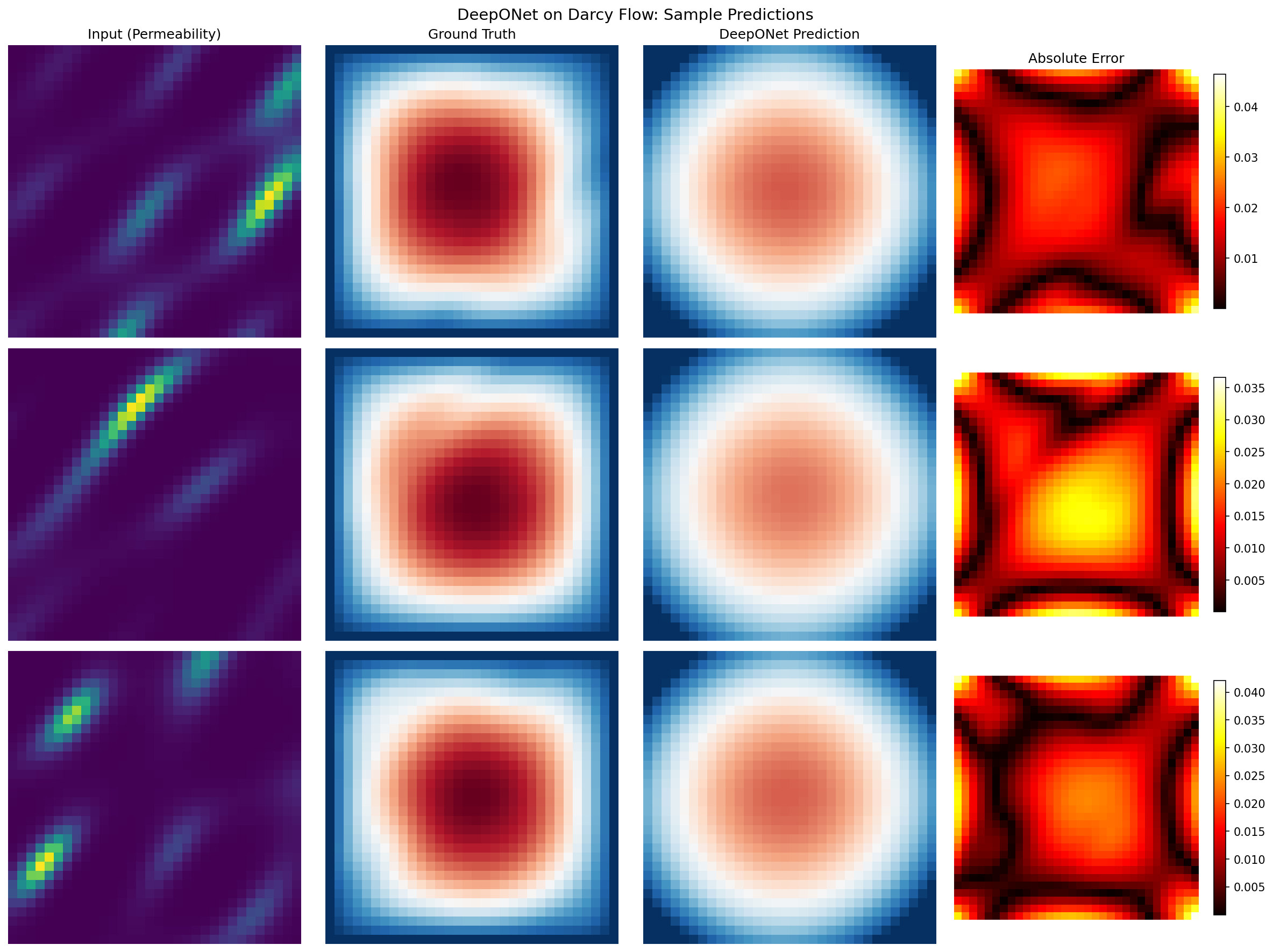
Input permeability, ground truth pressure, DeepONet prediction, and absolute error for three test samples:
Error Analysis
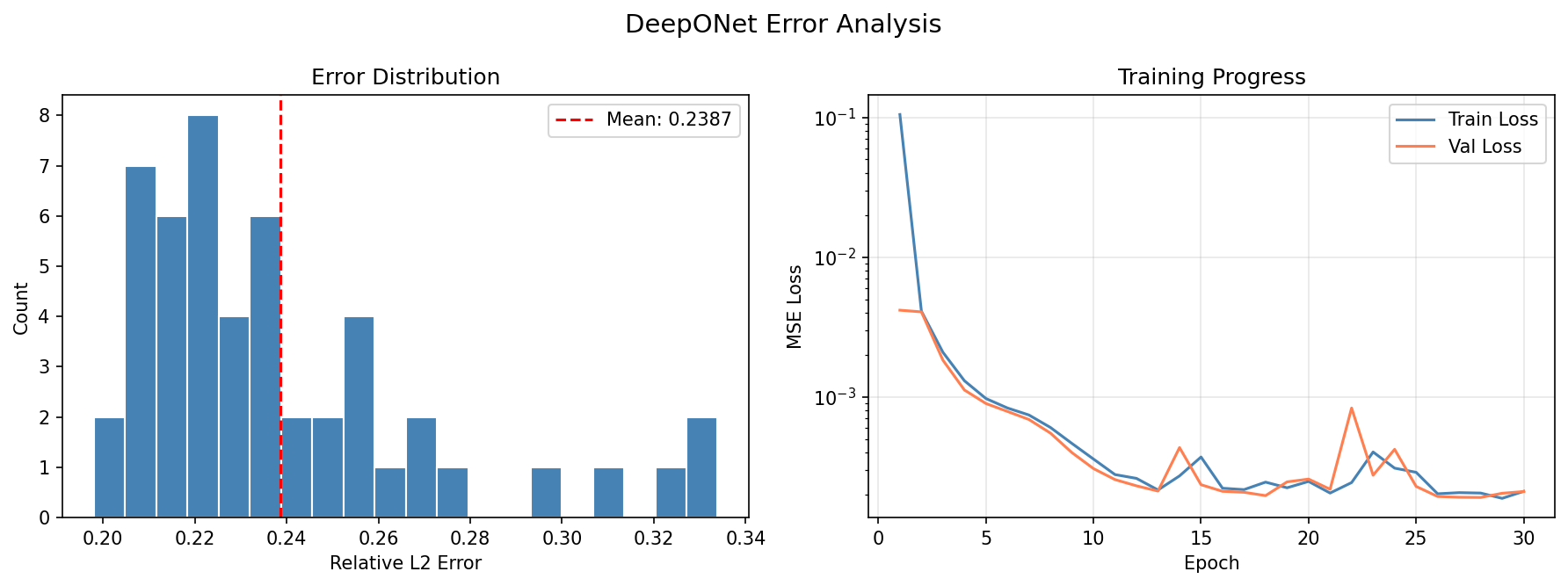
Error distribution across test samples and training convergence:
Branch-Trunk Embeddings
The learned branch and trunk representations reveal how DeepONet decomposes the operator:
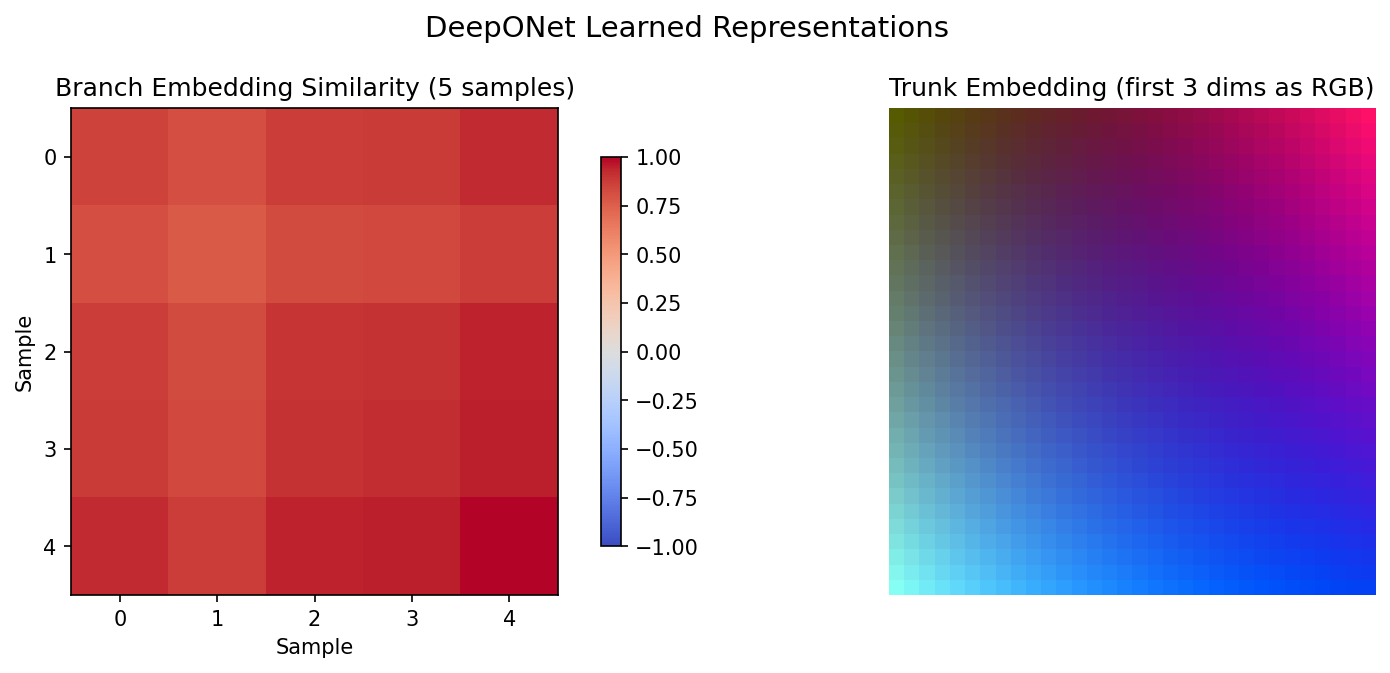
The trunk embedding (right) shows the spatial structure learned by the trunk network, while the branch similarity matrix (left) shows how different input functions are encoded in the latent space.
Results Summary
| Metric | Value |
|---|---|
| Test MSE | 6.16e-4 |
| Relative L2 Error | 0.0956 |
| Min / Max Relative L2 | 0.0451 / 0.4202 |
| Training Time | 20.5s (GPU) |
| Parameters | 411,008 |
| Final Train rel-L2 | 1.15e-1 |
| Final Val rel-L2 | 9.56e-2 |
The operator-learning recipe -- 1000 training samples, Gaussian normalization, and the relative-L2 objective with a warmup-cosine schedule -- drives the test relative L2 to ~0.096, substantially better than an unnormalized MSE-trained baseline.
Next Steps
Experiments to Try
- Increase latent dimension: Try
latent_dim=256for more expressive embeddings - Add more hidden layers: Deeper branch/trunk networks for complex operators
- Higher resolution: Apply to 64x64 or 128x128 grids (adjust sensor count)
- Periodic BCs: Modify trunk network to handle periodic boundary conditions
Related Examples
| Example | Level | What You'll Learn |
|---|---|---|
| DeepONet on Antiderivative | Intermediate | Classic operator learning task |
| FNO on Darcy Flow | Intermediate | Compare with grid-based FNO |
| UNO on Darcy Flow | Intermediate | Multi-scale UNO approach |
API Reference
DeepONet- Deep Operator Network model classDeepONetTrainerAdapter- Wraps DeepONet forBasicTrainercompatibility (accepts{'branch': ..., 'trunk': ...}dict input)create_darcy_loader- Darcy flow data loader
Troubleshooting
Shape mismatch between branch and trunk outputs
Symptom: Error like Incompatible shapes for dot: got (batch, 64) and (batch, 128).
Cause: Branch and trunk networks have different final dimensions.
Solution: Ensure the last element of branch_sizes and trunk_sizes match:
model = DeepONet(
    branch_sizes=[1024, 256, 128, 64],  # Last: 64
    trunk_sizes=[2, 128, 128, 64],       # Last: 64 (must match!)
    rngs=nnx.Rngs(42),
)
DeepONet doesn't work with Trainer
Symptom: Trainer.fit() fails with DeepONet.
Cause: Trainer expects single-input models, but DeepONet takes two inputs.
Solution: Use a custom training loop with nnx.Optimizer:
opt = nnx.Optimizer(model, optax.adam(1e-3), wrt=nnx.Param)

@nnx.jit
def train_step(model, opt, x_branch, x_trunk, y_target):
    def loss_fn(model):
        y_pred = model(x_branch, x_trunk)
        return jnp.mean((y_pred - y_target) ** 2)

    loss, grads = nnx.value_and_grad(loss_fn)(model)
    opt.update(model, grads)
    return loss
High relative L2 error
Symptom: Relative L2 error stays above 0.2 even after many epochs.
Cause: The operator-learning recipe is incomplete. Training on un-normalized fields with an MSE loss and too few samples leaves the branch network unable to encode the input function, and DeepONet's dot-product landscape plateaus early.
Solution: Apply the full recipe used in this example:
# 1. Use enough data (~1000 samples) and epochs (~300)
train_loader = create_darcy_loader(n_samples=1000, ...)

# 2. Gaussian-normalize the branch input and target on the TRAIN split
X_train_branch_n = (X_train_branch - x_mean) / x_std
Y_train_flat_n = (Y_train_flat - y_mean) / y_std

# 3. Optimize the relative-L2 loss (not MSE)
def relative_l2_loss(y_pred, y_target):
    num = jnp.linalg.norm(y_pred - y_target, axis=-1)
    den = jnp.linalg.norm(y_target, axis=-1) + 1e-8
    return jnp.mean(num / den)