NequIP on rMD17 (Aspirin)
| Metadata | Value |
|---|---|
| Level | Advanced |
| Runtime | ~60 min (GPU, scan-fused, early-stopped) |
| Prerequisites | JAX, Flax NNX, E(3)-equivariant networks, MLIPs |
| Format | Python + Jupyter |
| Memory | ~3 GB RAM |
Overview
This example trains a NequIP
machine-learning interatomic potential (MLIP) on the aspirin molecule from the
revised MD17 (rMD17) benchmark, fitting energies and conservative forces
jointly. NequIP (Batzner et al. 2022, arXiv:2101.03164) is an E(3)-equivariant
message-passing network: node features are steerable spherical tensors updated by
Clebsch-Gordan tensor-product convolutions on spherical-harmonic edge embeddings.
The total energy is an invariant scalar and the forces are its conservative
gradient F = -dE/dx, so they are energy-consistent by construction.
The example is deliberately thin — it composes opifex's committed atomistic stack and changes no library internals:
create_rmd17_loaderdownloads and caches aspirin, builds the canonical 1000/1000 train/validation split, and yields stacked{positions, energy, forces}batches.fit_atomic_scale_shift_from_forcesfits the per-atom energy shift and the force-RMS energy scale on the training split, so the network's gradient (the forces) sits at the natural scale of the data.NequIP+EnergyHead+ForcesHeadassemble into anAtomisticModel. The backbone uses the per-element (species-indexed) self-connection.make_scanned_epoch(per-atom-energy loss) fuses a whole epoch's energy+forces steps into one jittedlax.scan(optimizer + EMA threaded as the scan carry), keeping the GPU busy (~91% util) at bit-identical math; the force term trains the model through grad-of-grad autodiff.EarlyStopping+ReduceLROnPlateaudrive AdamW: the rate is cut on a validation plateau and training stops once it stalls, restoring the best weights.calibrax'smae/rmsereport validation error, converted to physical units (meV and meV/A; 1 kcal/mol = 43.364 meV).
What You'll Learn
- Load a real MLIP benchmark with
create_rmd17_loader - Normalize total energies with
fit_atomic_scale_shift - Assemble a NequIP
AtomisticModelwith energy and conservative-force heads - Train the joint energy+forces objective with the jitted atomistic step
- Evaluate energy/force MAE and RMSE in physical units
- Visualize energy parity, force-component parity, and the loss curve
Background: equivariant interatomic potentials
An interatomic potential maps atomic positions and species to a potential energy. For the dynamics to conserve energy, the forces must be the exact gradient of that energy. NequIP enforces both physical symmetries directly:
- Energy is E(3)-invariant — unchanged under rotation, translation, and reflection of the molecule, and under permutation of identical atoms.
- Forces are E(3)-equivariant — they rotate with the molecule, because they
are obtained by differentiating the invariant energy through
ForcesHead.
opifex builds NequIP from the native equivariant kit in
opifex.neural.equivariant (irreps, tensor products, spherical harmonics, gated
nonlinearities, Bessel radial bases). See
Atomistic Potentials for the
backbone → heads design.
Data and normalization
from opifex.data.loaders import create_rmd17_loader
from opifex.neural.atomistic import AtomisticBatch, fit_atomic_scale_shift
import jax.numpy as jnp

loaders = create_rmd17_loader(
    molecule="aspirin", n_train=1000, n_val=1000, batch_size=5, seed=0
)
atomic_numbers = jnp.asarray(loaders.atomic_numbers)  # (21,) for aspirin (C9H8O4)
Iterating a datarax pipeline once yields the split's {positions, energy,
forces} batches as stacked arrays sharing one atomic_numbers vector;
AtomisticBatch.from_arrays packs each into the JAX PyTree the jitted step
consumes — no per-configuration MolecularSystem round-trip:
def collect_batches(pipeline):
    return [
        AtomisticBatch.from_arrays(
            jnp.asarray(r["positions"]), atomic_numbers,
            jnp.asarray(r["energy"]), jnp.asarray(r["forces"]),
        )
        for r in pipeline
    ]

train_batches = collect_batches(loaders.train)
val_batches = collect_batches(loaders.val)
The total energy of aspirin is dominated by a near-constant sum of per-atom
reference energies (~ -400000 kcal/mol), so fitting it directly is badly
conditioned. fit_atomic_scale_shift_from_forces fits the MACE/NequIP affine
readout E = scale * E_raw + n_atoms * shift on the training split — shift
is the mean per-atom energy and scale is the root-mean-square of the forces.
Because the forces are the energy gradient, scaling the energy output by the force
RMS puts the network's gradient at the data scale. It is passed into the
EnergyHead:
train_energies = jnp.concatenate([b.energies for b in train_batches])
train_forces = jnp.concatenate([b.forces.reshape(-1) for b in train_batches])
atom_counts = jnp.full(train_energies.shape, float(atomic_numbers.shape[0]))
scale_shift = fit_atomic_scale_shift_from_forces(train_energies, atom_counts, train_forces)
Model assembly
The EnergyHead's feature_dim equals the number of 0e scalar channels in the
hidden irreps (64 here). The hyper-parameters follow the MACE-style rMD17 recipe
(Batzner et al. 2022, SI; Batatia et al. 2022): uniform-multiplicity steerable
features up to l_max = 2 (64 channels), five interaction layers, an 8-function
Bessel radial basis, a 5 A cutoff, and the higher-body-order symmetric contraction
(correlation = 3). species lists the distinct atomic numbers (H/C/O) for the
per-element self-connection and contraction weights; uniform multiplicity is
required by the channel-wise contraction.
from flax import nnx
from opifex.core.quantum.protocols import RadiusNeighborList
from opifex.neural.atomistic import AtomisticModel
from opifex.neural.atomistic.backbones import NequIP, NequIPConfig
from opifex.neural.atomistic.heads import EnergyHead, ForcesHead

rngs = nnx.Rngs(0)
backbone = NequIP(
    config=NequIPConfig(
        hidden_irreps="64x0e + 64x1o + 64x2e",  # uniform multiplicity
        sh_lmax=2,
        num_interactions=5,
        num_radial_basis=8,
        radial_hidden_dim=64,
        cutoff=5.0,
        average_num_neighbors=14.4,
        species=(1, 6, 8),
        correlation=3,  # MACE-style higher body order
    ),
    rngs=rngs,
)
model = AtomisticModel(
    backbone=backbone,
    heads={
        "energy": EnergyHead(feature_dim=64, scale_shift=scale_shift, rngs=rngs),
        "forces": ForcesHead(),
    },
    neighbor_list=RadiusNeighborList(cutoff=5.0),
    max_edges=atomic_numbers.shape[0] ** 2,
)
Training
make_scanned_epoch fuses a whole epoch's training steps into one jitted
jax.lax.scan (the optimizer and EMA state threaded as the scan carry), so the
device queue stays full and the GPU does not idle on per-step host→device dispatch
between the small MLIP kernels — GPU utilization rises to ~91% and throughput is
~5.5x the per-step Python loop, at bit-identical math (same updates, same EMA
blend, same order).
The objective is the NequIP loss: a per-atom-energy MSE plus the forces MSE at
equal weights. Dividing the energy error by the atom count makes the energy term
size-intensive and naturally commensurate with the per-component force MSE, so
neither term needs hand-weighting. Optimisation follows the NequIP recipe — AdamW at
a constant base rate with global-norm gradient clipping, a ReduceLROnPlateau
schedule that cuts the rate when the validation force error stops improving, and
EarlyStopping that ends training once it plateaus and restores the best (lowest-val)
EMA weights. The rate is exposed via optax.inject_hyperparams so the schedule can
cut it between epochs without resetting the optimiser moments.
import jax, optax
from opifex.core.training import EarlyStopping, ReduceLROnPlateau
from opifex.neural.atomistic import AtomisticBatch, make_scanned_epoch

optimizer = nnx.Optimizer(
    model,
    optax.chain(
        optax.clip_by_global_norm(1.0),
        optax.inject_hyperparams(optax.adamw)(learning_rate=5e-3, weight_decay=1e-5),
    ),
    wrt=nnx.Param,
)
lr_leaf = optimizer.opt_state[1].hyperparams["learning_rate"]  # mutable rate

# One scan-fused epoch: per-atom-energy loss with equal energy/force weights, EMA 0.999.
scanned_epoch = make_scanned_epoch(
    model, optimizer, energy_weight=1.0, force_weight=1.0,
    per_atom_energy=True, ema_decay=0.999,
)
stacked_train = AtomisticBatch.stack(train_batches)
ema_state = jax.tree.map(jnp.asarray, nnx.state(model, nnx.Param))

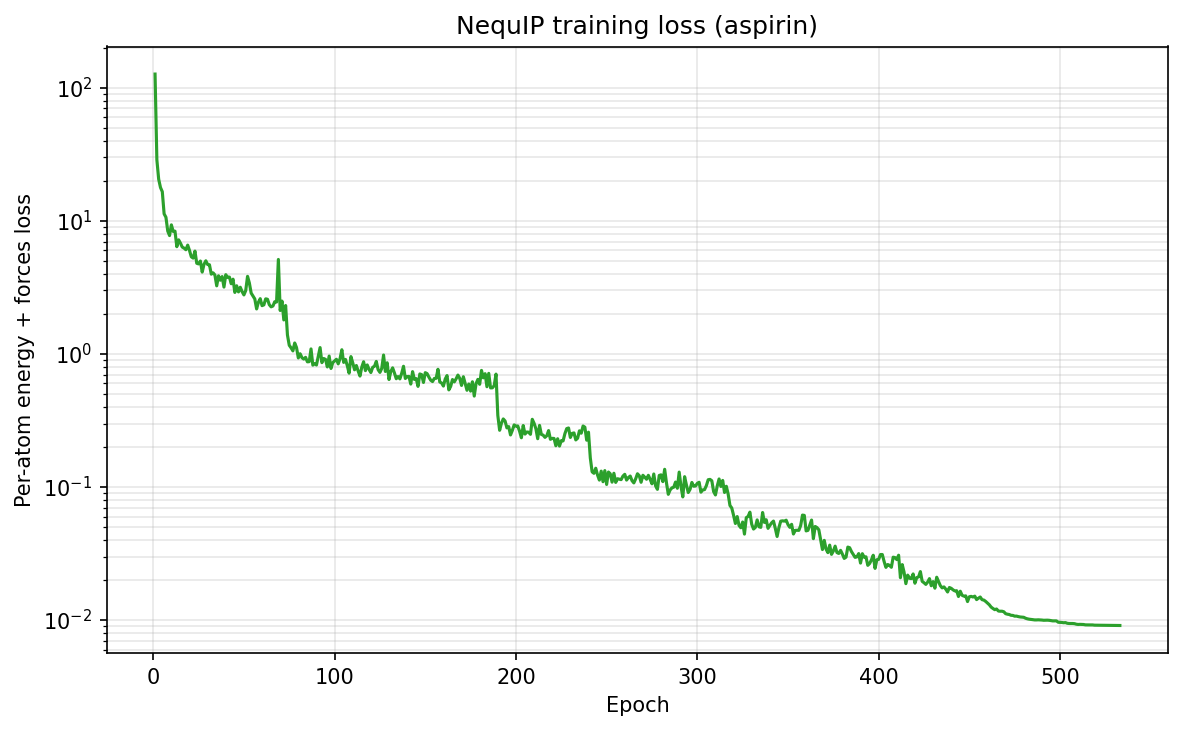
plateau = ReduceLROnPlateau(factor=0.6, patience=5, min_lr=1e-6)
early_stopping = EarlyStopping(patience=40)
best_ema_state = jax.tree.map(jnp.asarray, ema_state)
for epoch in range(1000):  # max; early stopping ends it sooner
    ema_state, losses = scanned_epoch(model, optimizer, stacked_train, ema_state)
    val_force_mae = evaluate_ema(model, ema_state, monitor_batches)["force_mae"]
    if early_stopping.update(val_force_mae):
        best_ema_state = jax.tree.map(jnp.asarray, ema_state)
    lr_leaf.value = jnp.asarray(plateau.update(val_force_mae, float(lr_leaf.value)))
    if early_stopping.should_stop:
        break
Because the forces are the energy gradient, the force term differentiates a gradient — the backbone is jit / grad / vmap clean for exactly this grad-of-grad path, and the scan is over training steps (each a full fwd+bwd), so the grad-of-grad is unaffected.
Following NequIP/MACE, the example keeps an exponential moving average of the
weights (decay 0.999) and evaluates against the smoothed weights, not the
noisy last-step ones. The EMA shadow is threaded through the scan carry and blended
inside the scan body, so make_scanned_epoch returns the updated ema_state per
epoch. The per-epoch plateau / early-stop metric is scored on a small held-out
monitor split (the full validation split would be host-bound every epoch); the best
EMA weights are restored for the final report on the full split.
Results
Validation error on the 1000-configuration aspirin test split, measured on a single GPU run of this example (early-stopped at ~530 scan-fused epochs, ~60 min on one RTX 4090 at ~91% GPU utilization) and evaluated against the best EMA (smoothed) weights. The published column is the canonical rMD17 @1000 benchmark — models trained on 950 configurations and validated on 50 — from Batzner et al. 2022 (NequIP, Nat. Commun.) as tabulated in Batatia et al. 2022 (MACE, NeurIPS, Table 1), which reports NequIP and MACE on the same split:
| Metric | This example | NequIP @1000 | MACE @1000 |
|---|---|---|---|
| Energy MAE | 4.76 meV | ~2.3 meV | ~2.2 meV |
| Energy RMSE | 7.12 meV | — | — |
| Force MAE | 15.33 meV/A | ~8 meV/A | ~6.6 meV/A |
| Force RMSE | 24.26 meV/A | — | — |
This opifex NequIP uses the MACE-style higher-body-order symmetric contraction
(correlation = 3) and is faithful to the canonical recipe — "component"
spherical-harmonic normalization, unit-second-moment gate activations, the
force-RMS energy scale, the linear_up/linear_down mixings, the per-element
self-connection, and the per-atom-energy loss with ReduceLROnPlateau + early
stopping. The energy MAE of 4.76 meV is single-digit-meV (~2x the published
~2.3 meV) and the force MAE of 15.33 meV/A approaches — but does not match —
the published ~6.6–8 meV/A.
The residual force gap is not architecture: precision (float64), l_max, the
interaction mixings, the per-element self-connection, the conditioning fixes, and
the higher-body-order contraction itself were each verified not to move the
force MAE off ~15 meV/A. It is training-recipe/budget bound — the published
NequIP/MACE numbers come from larger models (128–256 channels) trained on much
longer schedules. The contraction does, however, give the best energy MAE.
Energy and force parity
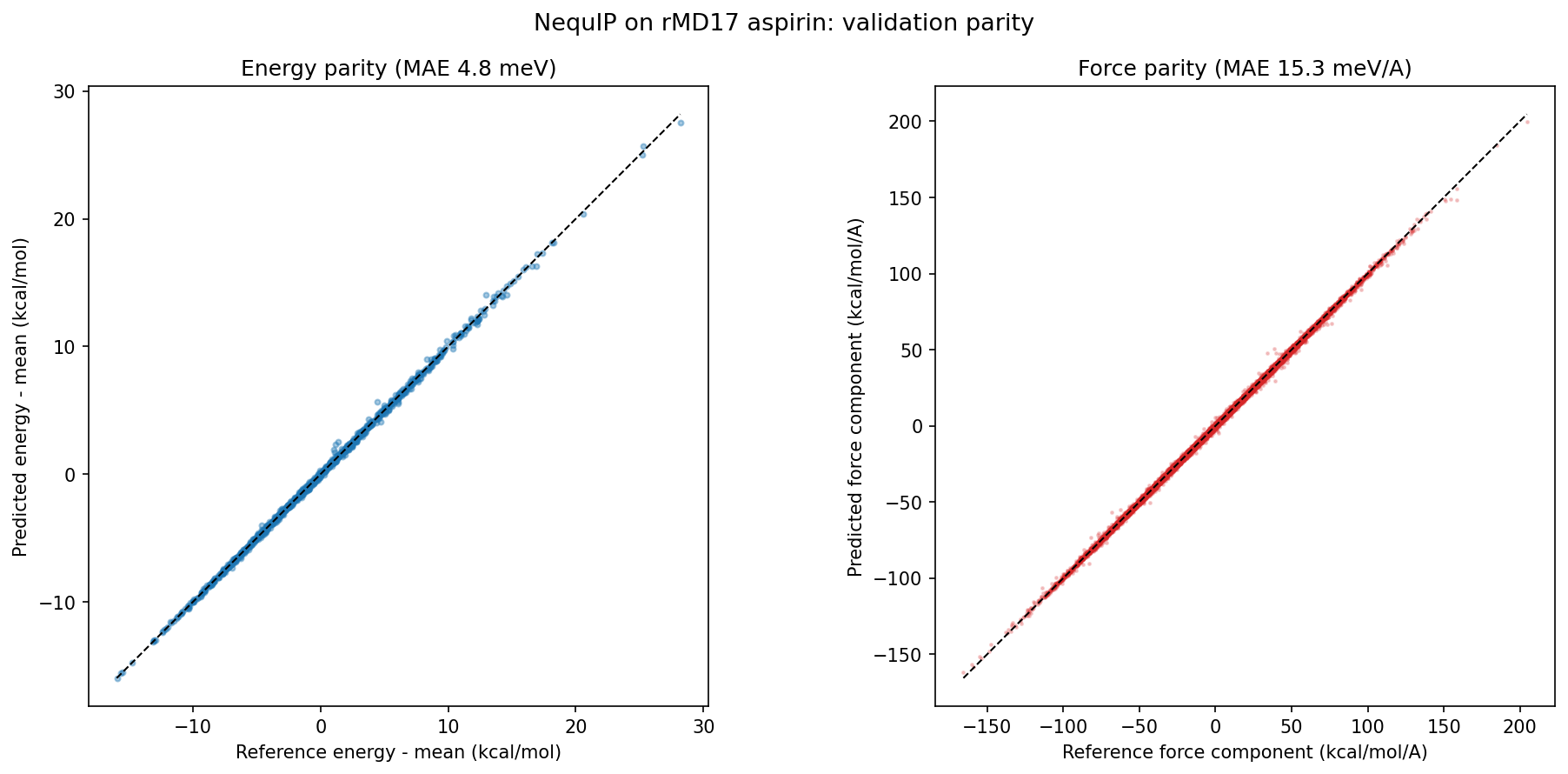
The energy parity is mean-centred so the residual interaction energy the network
actually learns is visible; the force parity shows all 3 * n_atoms Cartesian
components across the validation split.
Training loss
Running the example
The first run downloads the aspirin npz from figshare (~50 MB) and caches it
under ~/.cache/opifex/rmd17; subsequent runs reuse the cache.
Key takeaways
- A NequIP MLIP is a thin composition of the opifex atomistic stack: loader → scale-shift → backbone + heads → jitted energy+forces step → metrics.
- Energy normalization is essential — fitting the raw total energy is badly conditioned; the force-RMS scale-shift makes the network learn the small interaction energy and puts its gradient (the forces) at the data scale.
- Conservative forces come for free —
ForcesHeaddifferentiates the energy, so forces are energy-consistent and the joint loss is a grad-of-grad objective the equivariant backbone handles underjit/grad/vmap. - The per-atom-energy loss balances itself — dividing the energy error by the
atom count makes it commensurate with the force MSE at equal weights, so neither
term needs hand-tuning;
ReduceLROnPlateau+ early stopping (best-EMA restore) drive convergence. - The recipe approaches the published NequIP/MACE force accuracy on the rMD17
@1000 aspirin benchmark with the higher-body-order symmetric contraction
(
correlation = 3); the residual force gap is training-recipe/budget bound — body order,l_max, precision and conditioning were each ruled out — not a defect in the equivariant stack.
See also
- Atomistic Potentials — the backbone → heads design and the available backbones (SchNet, PaiNN, NequIP).
- Batzner et al. 2022, E(3)-equivariant graph neural networks for data-efficient and accurate interatomic potentials, Nat. Commun. 13, 2453 (arXiv:2101.03164).
- Batatia et al. 2022, MACE: Higher Order Equivariant Message Passing Neural Networks for Fast and Accurate Force Fields, NeurIPS 2022 (arXiv:2206.07697) — Table 1 reports the canonical rMD17 @1000 errors for NequIP, MACE, Allegro, and others.