Advection Equation PINN
| Metadata | Value |
|---|---|
| Level | Intermediate |
| Runtime | ~2 min (GPU) / ~8 min (CPU) |
| Prerequisites | JAX, Flax NNX, basic calculus |
| Format | Python + Jupyter |
| Memory | ~500 MB RAM |
Overview
This tutorial demonstrates solving the 1D linear advection equation using a Physics-Informed Neural Network (PINN). The advection equation describes pure transport of a quantity by a flow field without diffusion.
This is a fundamental hyperbolic PDE where information propagates along characteristic lines. PINNs must learn to track the traveling wave solution.
What You'll Learn
- Implement a PINN for first-order hyperbolic PDEs
- Handle inflow boundary conditions for transport problems
- Capture traveling wave solutions
- Understand the characteristic method interpretation
Coming from DeepXDE?
| DeepXDE | Opifex (JAX) |
|---|---|
dde.geometry.GeometryXTime(geom, time) |
jnp.column_stack([x, t]) for (x, t) |
dde.icbc.DirichletBC for inflow |
Custom inflow_loss() function |
dde.icbc.IC for initial condition |
Custom initial_loss() function |
model.train(iterations=10000) |
10000 epochs with Adam optimizer |
Key differences:
- Explicit gradients: Use
jax.gradfor automatic differentiation - Inflow BC: Handled via loss term matching analytical solution
- No special geometry: Simple uniform sampling in space-time domain
Files
- Python Script:
examples/pinns/advection.py - Jupyter Notebook:
examples/pinns/advection.ipynb
Quick Start
Run the Python Script
Run the Jupyter Notebook
Core Concepts
Advection Equation
\[\frac{\partial u}{\partial t} + c \frac{\partial u}{\partial x} = 0\]
| Component | This Example |
|---|---|
| Domain | \(x \in [0, 2]\), \(t \in [0, 1]\) |
| Velocity | \(c = 1\) |
| IC | Gaussian pulse \(u(x,0) = e^{-(x-0.5)^2/0.1}\) |
| BC | Inflow condition at \(x = 0\) |
| Solution | \(u(x,t) = u_0(x - ct)\) (traveling wave) |
Physical Interpretation
- Transport: Information propagates along characteristics \(x - ct = \text{const}\)
- No diffusion: The solution maintains its shape as it travels
- Inflow BC: At \(x=0\), we specify incoming values from the left boundary
Implementation
Step 1: Imports and Configuration
Terminal Output:
======================================================================
Opifex Example: Advection Equation PINN
======================================================================
JAX backend: gpu
JAX devices: [CudaDevice(id=0)]
Advection velocity: c = 1.0
Domain: x in [0.0, 2.0], t in [0.0, 1.0]
Collocation: 5000 domain, 200 inflow, 400 initial
Network: [2] + [40, 40, 40] + [1]
Training: 10000 epochs @ lr=0.001
Step 2: Define the Problem
C = 1.0  # Advection velocity

def exact_solution(x, t):
    """Exact solution: Gaussian pulse traveling with speed c."""
    x0 = 0.5
    sigma2 = 0.1
    return jnp.exp(-((x - C * t - x0) ** 2) / sigma2)

def initial_condition(x):
    """Initial condition: Gaussian pulse centered at x=0.5."""
    return jnp.exp(-((x - 0.5) ** 2) / 0.1)

def inflow_condition(t):
    """Inflow BC at x=0: u(0, t) matches analytical solution."""
    return jnp.exp(-((-C * t - 0.5) ** 2) / 0.1)
Terminal Output:
Advection equation: du/dt + c*du/dx = 0
  Velocity: c = 1.0
  IC: u(x, 0) = exp(-(x-0.5)^2 / 0.1)
  BC: u(0, t) = exact solution at inflow
  Solution: u(x, t) = u0(x - c*t)
Step 3: Create the PINN
class AdvectionPINN(nnx.Module):
    def __init__(self, hidden_dims: list[int], *, rngs: nnx.Rngs):
        super().__init__()
        layers = []
        in_features = 2  # (x, t)

        for hidden_dim in hidden_dims:
            layers.append(nnx.Linear(in_features, hidden_dim, rngs=rngs))
            in_features = hidden_dim

        layers.append(nnx.Linear(in_features, 1, rngs=rngs))
        self.layers = nnx.List(layers)

    def __call__(self, xt: jax.Array) -> jax.Array:
        h = xt
        for layer in self.layers[:-1]:
            h = jnp.tanh(layer(h))
        return self.layers[-1](h)

pinn = AdvectionPINN(hidden_dims=[40, 40, 40], rngs=nnx.Rngs(42))
Terminal Output:
Step 4: Generate Collocation Points
key = jax.random.PRNGKey(42)
keys = jax.random.split(key, 4)

# Domain interior points
x_domain = jax.random.uniform(keys[0], (N_DOMAIN,), minval=X_MIN, maxval=X_MAX)
t_domain = jax.random.uniform(keys[1], (N_DOMAIN,), minval=T_MIN, maxval=T_MAX)
xt_domain = jnp.column_stack([x_domain, t_domain])

# Inflow boundary (x = 0)
t_inflow = jax.random.uniform(keys[2], (N_BOUNDARY,), minval=T_MIN, maxval=T_MAX)
xt_inflow = jnp.column_stack([jnp.zeros(N_BOUNDARY), t_inflow])
u_inflow = inflow_condition(t_inflow)

# Initial condition (t = 0)
x_initial = jax.random.uniform(keys[3], (N_INITIAL,), minval=X_MIN, maxval=X_MAX)
xt_initial = jnp.column_stack([x_initial, jnp.zeros(N_INITIAL)])
u_initial = initial_condition(x_initial)
Terminal Output:
Generating collocation points...
Domain points:   (5000, 2)
Inflow points:   (200, 2)
Initial points:  (400, 2)
Step 5: Define Physics-Informed Loss
def compute_pde_residual(pinn, xt):
    """Compute advection PDE residual: u_t + c*u_x = 0."""

    def u_scalar(xt_single):
        return pinn(xt_single.reshape(1, 2)).squeeze()

    def residual_single(xt_single):
        grad_u = jax.grad(u_scalar)(xt_single)
        u_x = grad_u[0]
        u_t = grad_u[1]
        return u_t + C * u_x

    return jax.vmap(residual_single)(xt)

def total_loss(pinn, xt_dom, xt_ic, u_ic, xt_in, u_in, lambda_bc=10.0):
    loss_pde = pde_loss(pinn, xt_dom)
    loss_ic = initial_loss(pinn, xt_ic, u_ic)
    loss_in = inflow_loss(pinn, xt_in, u_in)
    return loss_pde + lambda_bc * (loss_ic + loss_in)
Step 6: Training
opt = nnx.Optimizer(pinn, optax.adam(LEARNING_RATE), wrt=nnx.Param)

@nnx.jit
def train_step(pinn, opt, xt_dom, xt_ic, u_ic, xt_in, u_in):
    def loss_fn(model):
        return total_loss(model, xt_dom, xt_ic, u_ic, xt_in, u_in)

    loss, grads = nnx.value_and_grad(loss_fn)(pinn)
    opt.update(pinn, grads)
    return loss

for epoch in range(EPOCHS):
    loss = train_step(pinn, opt, xt_domain, xt_initial, u_initial, xt_inflow, u_inflow)
Terminal Output:
Training PINN...
  Epoch     1/10000: loss=3.735486e+00
  Epoch  2000/10000: loss=5.986348e-04
  Epoch  4000/10000: loss=1.633124e-04
  Epoch  6000/10000: loss=1.010060e-04
  Epoch  8000/10000: loss=1.360641e-04
  Epoch 10000/10000: loss=6.163503e-06
Final loss: 6.163503e-06
Step 7: Evaluation
Terminal Output:
Evaluating PINN...
Relative L2 error:   1.866364e-03
Maximum point error: 3.505945e-03
Mean point error:    6.586521e-04
Mean PDE residual:   1.024557e-03
Visualization
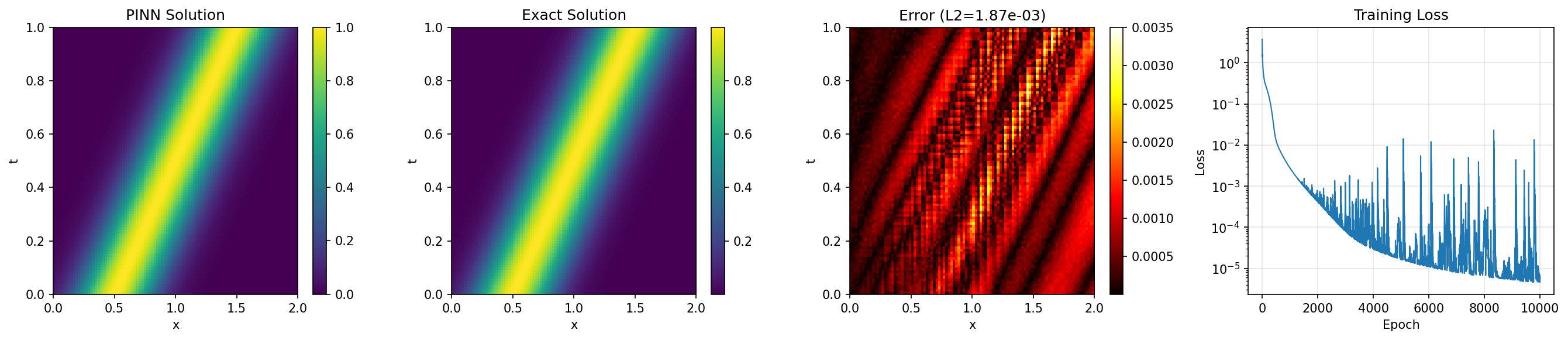
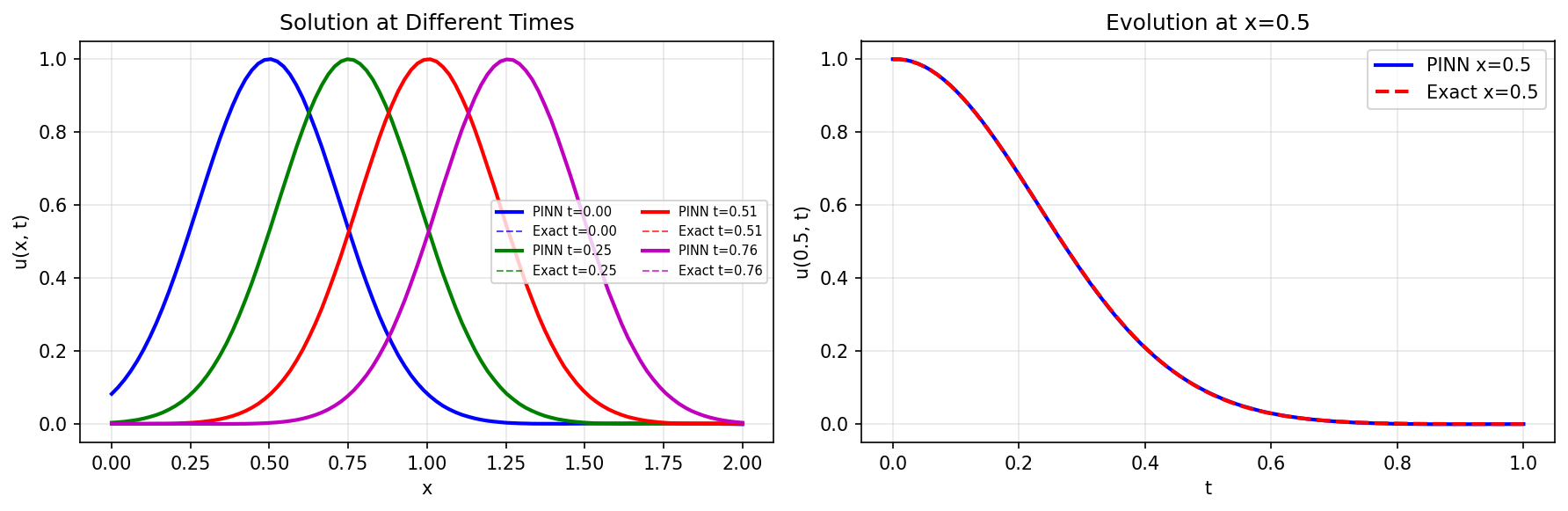
Results Summary
| Metric | Value |
|---|---|
| Final Loss | 6.16e-06 |
| Relative L2 Error | 0.19% |
| Maximum Point Error | 3.51e-03 |
| Mean Point Error | 6.59e-04 |
| Mean PDE Residual | 1.02e-03 |
| Parameters | 3,441 |
| Training Epochs | 10,000 |
Next Steps
Experiments to Try
- Vary velocity: Try \(c = 2\) or \(c = 0.5\) to see different propagation speeds
- Different IC: Use a step function or sinusoidal initial condition
- Longer time: Extend domain to \(t \in [0, 2]\) to track the wave further
- Higher resolution: Increase collocation points for better accuracy
Related Examples
| Example | Level | What You'll Learn |
|---|---|---|
| Burgers Equation | Intermediate | Nonlinear advection-diffusion |
| Wave Equation | Intermediate | Second-order hyperbolic |
| Heat Equation | Beginner | Pure diffusion (parabolic) |
Troubleshooting
| Issue | Solution |
|---|---|
| Poor tracking at late times | Increase training epochs or add more collocation points near later times |
| Oscillations near boundaries | Check inflow condition matches analytical solution exactly |
| Slow convergence | Try learning rate scheduling or increase lambda_bc weight |