GradNorm: Automatic Loss Balancing for PINNs
| Level | Runtime | Prerequisites | Format | Memory |
|---|---|---|---|---|
| Advanced | ~3 min | Multi-objective training | Tutorial | ~500 MB |
Overview
This example demonstrates how to use GradNorm for automatic loss weight balancing in multi-objective PINN training. GradNorm dynamically adjusts weights to equalize gradient contributions across loss components.
SciML Context: PINNs with multiple loss terms (PDE residual, boundary conditions, initial conditions) often suffer from gradient imbalance - one loss dominates and prevents others from decreasing. GradNorm solves this automatically.
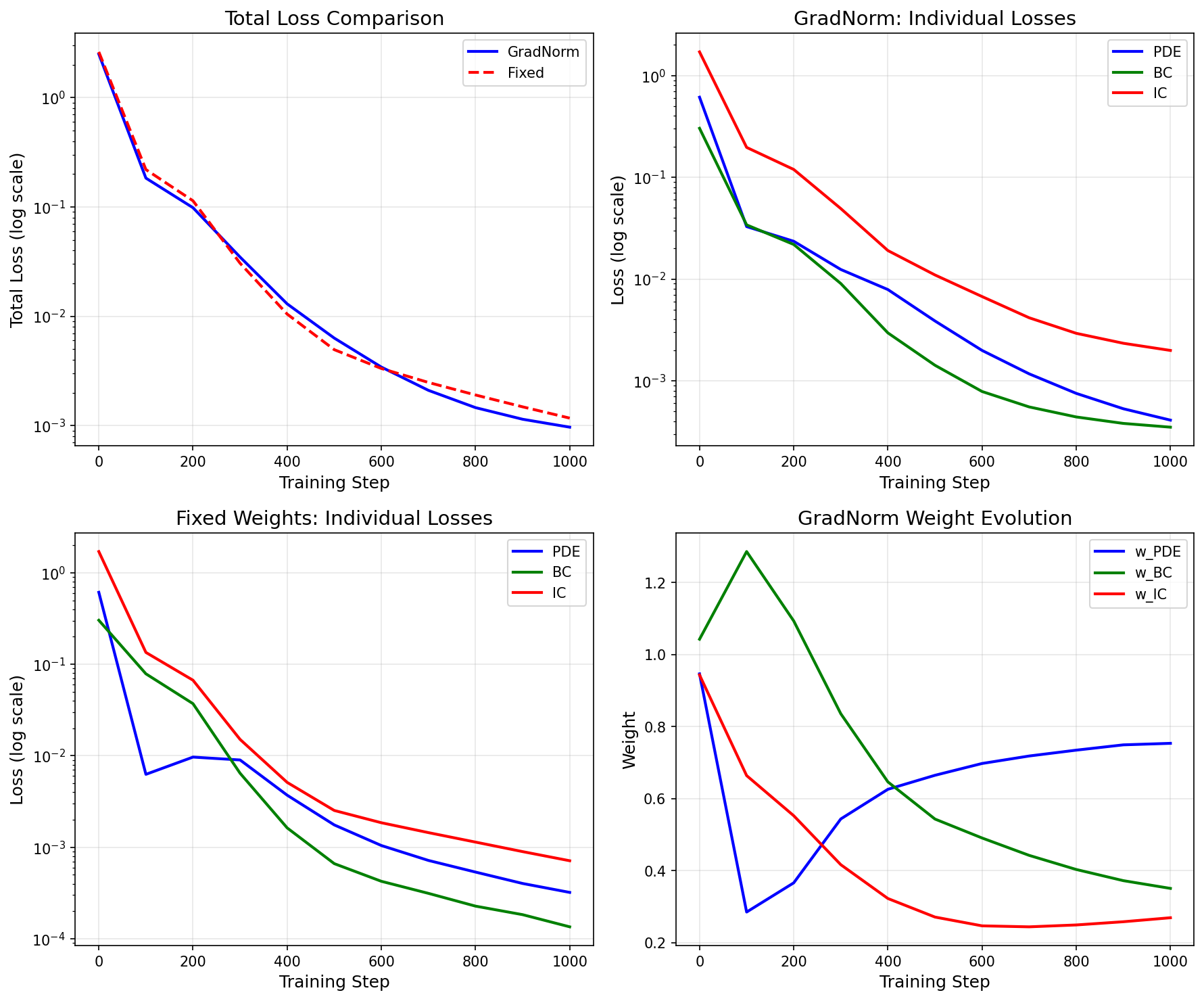
Key Result: GradNorm automatically adapts weights from [1, 1, 1] to [0.75, 0.35, 0.27], balancing training across PDE, BC, and IC losses.
What You'll Learn
- Understand the gradient imbalance problem in multi-objective training
- Implement GradNorm with Opifex's
GradNormBalancer - Configure the alpha parameter for different balancing behaviors
- Compare GradNorm against fixed weight baselines
- Visualize weight evolution during training
Coming from Other Frameworks?
| Framework | Loss Balancing | Opifex Equivalent |
|---|---|---|
| DeepXDE | Static 1/initial_loss |
GradNormBalancer.update_weights() |
| PhysicsNeMo | Manual per-field weights | GradNormConfig(alpha=1.5) |
| NeuralOperator | SoftAdapt, ReLoBRaLo | GradNormBalancer (GradNorm algorithm) |
Note: GradNorm (Chen et al. 2018) uses gradient norms, unlike SoftAdapt/ReLoBRaLo which use loss ratios.
Files
- Python script:
examples/advanced-training/gradnorm.py - Jupyter notebook:
examples/advanced-training/gradnorm.ipynb
Quick Start
Run the script
Run the notebook
Core Concepts
The Gradient Imbalance Problem
In multi-objective PINN training, different losses often have very different gradient magnitudes:
- PDE loss: Gradients from second-order derivatives (often large)
- BC loss: Gradients from boundary samples (often smaller)
- IC loss: Gradients from initial condition (varies)
Without balancing, the loss with largest gradients dominates training.
GradNorm Algorithm
GradNorm adjusts weights to equalize gradient contributions:
Where: - \(w_i\) = weight for loss \(i\) - \(\nabla L_i\) = gradient of loss \(i\) - \(\bar{G}\) = mean gradient norm - \(r_i\) = relative inverse training rate - \(\alpha\) = asymmetry parameter
graph TD
    A[Compute Individual Losses] --> B[Compute Gradients]
    B --> C[Compute Gradient Norms]
    C --> D[Calculate Training Rates]
    D --> E[Update Weights via GradNorm]
    E --> F[Weighted Total Loss]
    F --> G[Backpropagate]
    G --> A
Alpha Parameter
| Alpha | Effect |
|---|---|
| α = 0 | Equal weighting for all tasks |
| α = 1 | Moderate balancing |
| α = 1.5 | Strong balancing (default) |
| α > 2 | Very aggressive balancing |
Implementation
Step 1: Setup GradNorm Balancer
from opifex.core.physics.gradnorm import GradNormBalancer, GradNormConfig

config = GradNormConfig(
    alpha=1.5,           # Asymmetry parameter
    learning_rate=0.01,  # Learning rate for weight updates
    update_frequency=1,  # Update weights every step
)

balancer = GradNormBalancer(
    num_losses=3,  # PDE, BC, IC
    config=config,
    rngs=nnx.Rngs(SEED),
)
Terminal Output:
Setting up GradNorm balancer...
  GradNorm alpha: 1.5
  Weight learning rate: 0.01
  Initial weights: [1. 1. 1.]
Step 2: Training Loop with GradNorm
for step in range(TRAINING_STEPS):
    # Compute individual losses
    losses = compute_losses(pinn)

    # Compute gradient norms
    grad_norms = compute_gradient_norms(pinn, loss_fns)

    # Update GradNorm weights
    balancer.update_weights(grad_norms, losses, initial_losses)

    # Compute weighted loss
    total_loss = balancer.compute_weighted_loss(losses)

    # Backpropagate and update model
    grads = nnx.value_and_grad(total_loss_fn)(pinn)
    opt.update(pinn, grads)
Terminal Output:
Training PINN with GradNorm...
--------------------------------------------------
Initial losses: PDE=0.6117, BC=0.3028, IC=1.7055
  Step    0: loss=2.502858e+00, PDE=6.1175e-01, BC=3.0275e-01, IC=1.7055e+00
           weights: PDE=0.946, BC=1.042, IC=0.943
  Step  100: loss=1.835124e-01, PDE=3.2745e-02, BC=3.4047e-02, IC=1.9649e-01
           weights: PDE=0.285, BC=1.286, IC=0.664
  Step  500: loss=6.310889e-03, PDE=3.8685e-03, BC=1.4199e-03, IC=1.0959e-02
           weights: PDE=0.665, BC=0.543, IC=0.271
  Step 1000: loss=9.661791e-04, PDE=4.1043e-04, BC=3.4987e-04, IC=1.9863e-03
Step 3: Compare with Fixed Weights
# Fixed weights baseline
for step in range(TRAINING_STEPS):
    total_loss = FIXED_WEIGHT * (pde_loss + bc_loss + ic_loss)
    # ... train without adaptive balancing
Terminal Output:
Training PINN with fixed weights (baseline)...
--------------------------------------------------
  Step    0: loss=2.620038e+00
  Step  500: loss=4.945495e-03
  Step 1000: loss=1.172044e-03
Visualization
Training Comparison
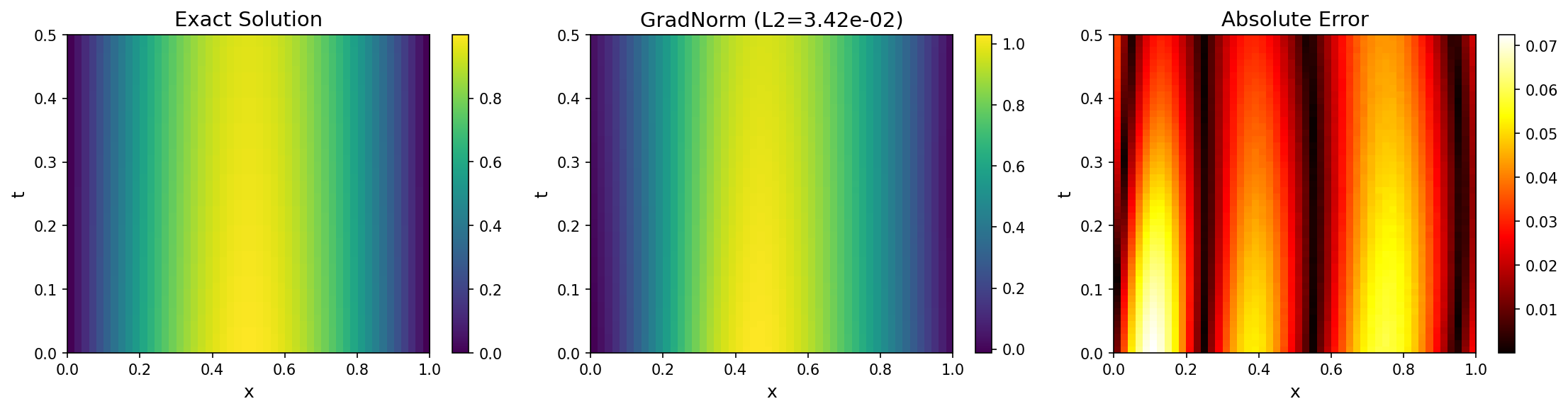
Solution Quality
Results Summary
| Method | Final Loss | PDE Loss | BC Loss | IC Loss |
|---|---|---|---|---|
| GradNorm | 9.66e-04 | 4.10e-04 | 3.50e-04 | 1.99e-03 |
| Fixed | 1.17e-03 | 3.21e-04 | 1.35e-04 | 7.13e-04 |
Final Weights (GradNorm): - w_PDE = 0.753 - w_BC = 0.350 - w_IC = 0.269
Key Insights:
- GradNorm automatically discovers appropriate weight ratios
- Weights adapt based on gradient magnitudes and training rates
- All loss components decrease together (balanced training)
- For well-conditioned problems, fixed weights may perform similarly
Next Steps
Experiments to Try
- Vary alpha: Compare α=0.5, α=1.0, α=2.0
- Challenging problems: Use when BC/IC losses dominate
- Learning rate: Adjust GradNorm learning rate for stability
- Combine with NTK: Use NTK to diagnose, GradNorm to balance
Related Examples
- NTK Analysis - Diagnose training dynamics
- Adaptive Sampling - Focus points where needed
- Heat Equation PINN - Basic PINN training
API Reference
Troubleshooting
Weights oscillating
- Reduce
learning_ratein GradNormConfig - Try lower
alpha(e.g., 0.5) - Weights need time to stabilize
One weight becomes very large/small
- This is expected if tasks have very different difficulties
- Check
min_weightandmax_weightbounds - Consider if the imbalanced loss is appropriate
No improvement over fixed weights
- GradNorm helps most when losses have different scales
- For well-conditioned problems, fixed weights may suffice
- Try on problems with known gradient imbalance
NaN in weights
- Check for NaN in losses or gradients first
- Add epsilon to gradient norms for stability
- Reduce learning rate