Skip to content

Spectral Normalization for Neural Operators

Metadata Value
Level Intermediate
Runtime ~5 min (CPU)
Prerequisites JAX, Flax NNX, Linear Algebra basics
Format Python + Jupyter

Overview

Spectral normalization controls the Lipschitz constant of neural network layers by normalizing weight matrices by their spectral norm (largest singular value). This is critical for PDE-solving neural operators where stability and convergence guarantees depend on bounded operator norms.

This example demonstrates spectral normalized linear layers, convolutions, and attention mechanisms. It includes stability analysis comparing regular vs spectral normalized networks, adaptive bounds, power iteration algorithm details, and performance benchmarks.

What You'll Learn

  1. Apply SpectralLinear and SpectralNormalizedConv for stable neural operator layers
  2. Use SpectralMultiHeadAttention for normalized attention mechanisms
  3. Configure AdaptiveSpectralNorm with fixed and learnable bounds
  4. Analyze Lipschitz constants to verify stability improvements
  5. Build complete spectral normalized neural operators with create_spectral_neural_operator

Files

Quick Start

source activate.sh && python examples/layers/spectral_normalization_example.py

Core Concepts

Why Spectral Normalization?

Neural operators learn mappings between function spaces. Without normalization, weight matrices can have arbitrarily large spectral norms, leading to:

  • Exploding gradients during training
  • Unstable predictions that amplify input perturbations
  • Poor generalization due to lack of Lipschitz control

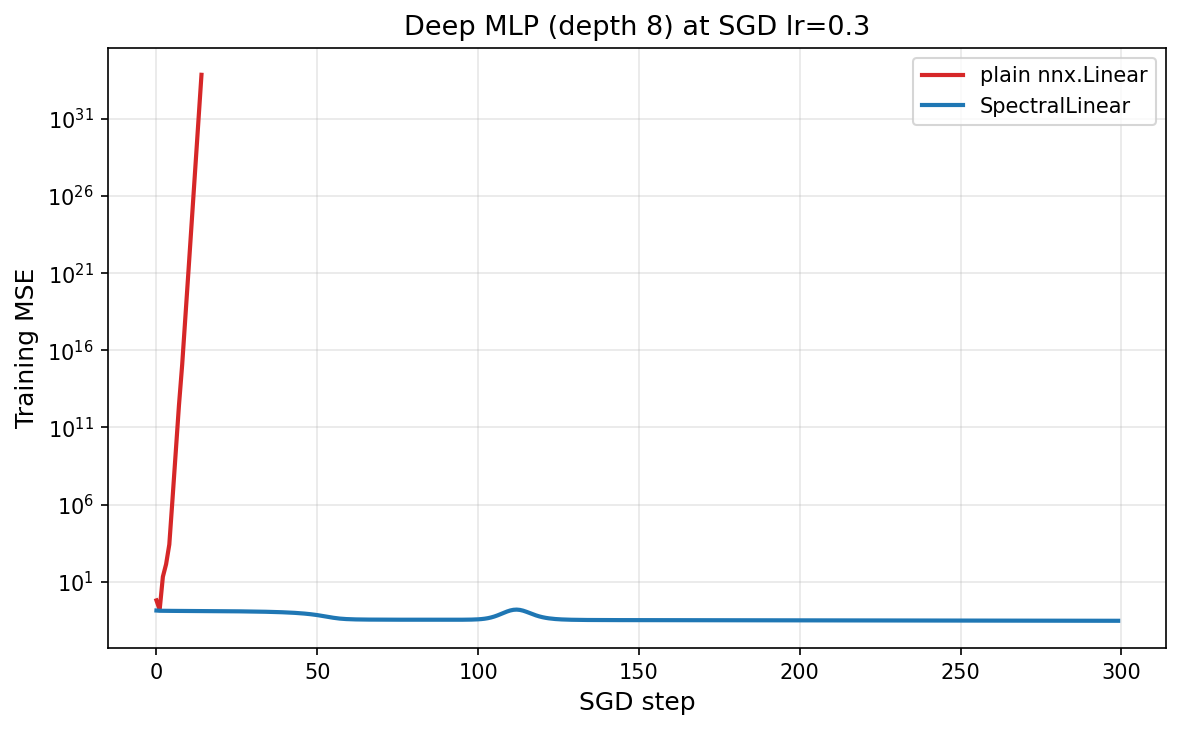
Spectral normalization bounds the spectral norm to 1 (or a configurable bound), ensuring controlled sensitivity to input changes.

graph TB
    subgraph Without["Without Spectral Norm"]
        A1["Input x"] --> B1["W (unbounded)"]
        B1 --> C1["Output Wx<br/>(can explode)"]
    end

    subgraph With["With Spectral Norm"]
        A2["Input x"] --> B2["W/sigma(W)"]
        B2 --> C2["Output<br/>(bounded response)"]
    end

    style Without fill:#fce4ec
    style With fill:#e3f2fd

Power Iteration Algorithm

Computing the exact spectral norm requires SVD (O(n^3)). Power iteration provides an efficient O(n) approximation by iteratively refining an estimate of the largest singular value:

Iterations Accuracy Cost
1 Approximate Minimal overhead
3-5 Good for training Standard choice
10+ Near-exact Higher overhead

Implementation

Step 1: Basic Spectral Normalization Layers

Replace standard layers with spectral normalized variants:

from opifex.neural.operators.specialized.spectral_normalization import (
    SpectralLinear,
    SpectralNormalizedConv,
)

# Spectral normalized linear layer
spectral_linear = SpectralLinear(10, 5, power_iterations=5, rngs=rngs)
y = spectral_linear(x, training=True)

# Spectral normalized convolution
spectral_conv = SpectralNormalizedConv(3, 16, kernel_size=3, power_iterations=3, rngs=rngs)
y_conv = spectral_conv(x_img, training=True)

Terminal Output:

BASIC SPECTRAL NORMALIZATION LAYERS
==================================================

Linear Layer Comparison:
   Regular Linear: (8, 10) -> (8, 5)
   Spectral Linear: (8, 10) -> (8, 5)
   Regular kernel spectral norm: 2.018
   Spectral normalized estimate: 1.434

Convolution Layer Comparison:
   Regular Conv: (4, 32, 32, 3) -> (4, 32, 32, 16)
   Spectral Conv: (4, 32, 32, 3) -> (4, 32, 32, 16)

Step 2: Spectral Normalized Attention

Multi-head attention with spectral normalization for stable sequence processing:

from opifex.neural.operators.specialized.spectral_normalization import SpectralMultiHeadAttention

spectral_attention = SpectralMultiHeadAttention(
    num_heads=8,
    in_features=64,
    power_iterations=3,
    rngs=rngs,
)

output = spectral_attention(x, training=True)

Terminal Output:

SPECTRAL NORMALIZED ATTENTION
==================================================
Attention configuration:
   Number of heads: 8
   Feature dimension: 64
   Head dimension: 8

Processing sequence: (2, 32, 64)
   Output shape: (2, 32, 64)

Step 3: Adaptive Spectral Normalization

AdaptiveSpectralNorm allows per-layer spectral bound tuning, with optional learnable bounds:

from opifex.neural.operators.specialized.spectral_normalization import AdaptiveSpectralNorm

adaptive_layer = AdaptiveSpectralNorm(
    base_linear,
    power_iterations=5,
    initial_bound=1.0,
    learnable_bound=True,  # Bound adjusts during training
    rngs=rngs,
)

Terminal Output:

ADAPTIVE SPECTRAL NORMALIZATION
==================================================
Fixed bound (1.0):
   Initial bound: 1.0
   Learnable: False
Learnable bound:
   Initial bound: 1.0
   Learnable: True

Step 4: Power Iteration Algorithm

The core algorithm for efficient spectral norm estimation, tested against exact SVD computation:

Terminal Output:

POWER ITERATION ALGORITHM
==================================================

Matrix: Identity (shape: (4, 4))
   True spectral norm (SVD): 1.000000
    1 iterations: 1.000000 (error: 0.000000, time: 344.39 ms)
    3 iterations: 1.000000 (error: 0.000000, time: 3.84 ms)
    5 iterations: 1.000000 (error: 0.000000, time: 3.66 ms)
   10 iterations: 1.000000 (error: 0.000000, time: 5.34 ms)

Matrix: Diagonal (shape: (4, 4))
   True spectral norm (SVD): 3.000000
    1 iterations: 2.682737 (error: 0.317263, time: 2.15 ms)
    3 iterations: 2.988353 (error: 0.011647, time: 4.91 ms)
    5 iterations: 2.999541 (error: 0.000459, time: 2.64 ms)
   10 iterations: 3.000000 (error: 0.000000, time: 3.78 ms)

Matrix: Random (shape: (6, 4))
   True spectral norm (SVD): 3.189911
    1 iterations: 2.980349 (error: 0.209562, time: 363.63 ms)
    3 iterations: 3.117129 (error: 0.072781, time: 3.76 ms)
    5 iterations: 3.170034 (error: 0.019876, time: 3.06 ms)
   10 iterations: 3.189305 (error: 0.000606, time: 4.89 ms)

Matrix: Large Random (shape: (128, 64))
   True spectral norm (SVD): 18.911154
    1 iterations: 14.052646 (error: 4.858508, time: 356.26 ms)
    3 iterations: 17.750385 (error: 1.160769, time: 2.42 ms)
    5 iterations: 18.417088 (error: 0.494066, time: 2.52 ms)
   10 iterations: 18.828447 (error: 0.082706, time: 3.36 ms)

Step 5: Stability Analysis

Comparing Lipschitz constants between regular and spectral normalized networks:

Terminal Output:

STABILITY ANALYSIS & LIPSCHITZ CONTROL
==================================================
Network configurations:
   Regular: Linear layers with standard weights
   Spectral: SpectralLinear layers with spectral normalization

Lipschitz constant estimation:
   Regular network:
     Mean Lipschitz: 0.396 +/- 0.158
     Max Lipschitz: 0.927
   Spectral normalized network:
     Mean Lipschitz: 0.066 +/- 0.030
     Max Lipschitz: 0.168

Step 6: Complete Spectral Neural Operators

Building full architectures with varying sizes:

from opifex.neural.operators.fno.spectral import create_spectral_neural_operator

model = create_spectral_neural_operator(
    input_dim=64,
    output_dim=64,
    hidden_dims=(128, 128, 64),
    num_heads=8,
    power_iterations=3,
    rngs=rngs,
)

Terminal Output:

COMPLETE SPECTRAL NEURAL OPERATORS
==================================================

Creating Small FNO-style:
   Input/Output dims: 32 -> 32
   Hidden layers: (64, 64)
   Attention heads: 4
   Creation time: 387.87 ms

Creating Medium PDE solver:
   Input/Output dims: 64 -> 64
   Hidden layers: (128, 128, 64)
   Attention heads: 8
   Creation time: 633.09 ms

Creating Large Multi-scale:
   Input/Output dims: 128 -> 64
   Hidden layers: (256, 192, 128, 96)
   Attention heads: 16
   Creation time: 959.89 ms

Testing forward passes:
   Small FNO-style: (4, 32) -> (4, 32) (698.53 ms)
   Medium PDE solver: (4, 64) -> (4, 64) (414.97 ms)
   Large Multi-scale: (4, 128) -> (4, 64) (2268.00 ms)

Results Summary

Component Benefit Overhead
SpectralLinear Bounded Lipschitz constant ~10-30%
SpectralNormalizedConv Stable spatial processing ~15-25%
SpectralMultiHeadAttention Stable attention weights ~10-20%
AdaptiveSpectralNorm Flexible per-layer control ~10-20%
PowerIteration Efficient O(n) norm estimation Configurable

Key Takeaways

  • Spectral normalization controls Lipschitz constants for stable training
  • Power iteration provides efficient O(n) spectral norm estimation
  • Adaptive bounds allow layer-specific flexibility
  • JAX transformations (JIT, grad, vmap, Hessian) work seamlessly
  • Modest overhead (~10-30%) for significant stability improvements
  • Particularly beneficial for PDE-solving neural operators

Next Steps

Experiments to Try

  1. FNO with spectral norm: Apply SpectralLinear to FNO spectral layers for stable Darcy flow training
  2. PINN stability: Compare PINN training convergence with and without spectral normalization
  3. Adaptive bounds: Use learnable bounds with AdaptiveSpectralNorm for multi-scale architectures
Example Level What You'll Learn
Grid Embeddings Beginner Spatial coordinate injection
FNO Darcy Full Intermediate Apply spectral layers in training
Neural Operator Benchmark Advanced Cross-architecture comparison

API Reference

Troubleshooting

Spectral norm not converging

Symptom: Power iteration estimates vary significantly between forward passes.

Cause: Too few power iterations for the matrix size.

Solution: Increase power_iterations (3-5 is typical, use 10+ for large matrices):

layer = SpectralLinear(512, 256, power_iterations=10, rngs=rngs)

Training loss oscillating

Symptom: Loss oscillates when using spectral normalization.

Cause: Spectral bound may be too restrictive, limiting model capacity.

Solution: Use AdaptiveSpectralNorm with a larger initial bound:

adaptive = AdaptiveSpectralNorm(
    base_layer,
    initial_bound=2.0,      # Allow larger spectral norm
    learnable_bound=True,   # Let the model find the right bound
    rngs=rngs,
)

training parameter confusion

Symptom: Different results with training=True vs training=False.

Cause: Power iteration updates internal state during training=True. During inference, use training=False to use cached spectral norm.

Solution:

# During training
output = layer(x, training=True)   # Updates spectral norm estimate

# During inference
output = layer(x, training=False)  # Uses cached estimate