Equation Discovery with SINDy
Automatically discover governing equations from time-series data using Sparse Identification of Nonlinear Dynamics (SINDy).
Source: examples/discovery/sindy_lorenz.py |
sindy_lorenz.ipynb
Overview
SINDy discovers the sparsest set of nonlinear functions that explains observed dynamics. Given state data \(x(t)\) and derivatives \(\dot{x}\), it solves:
where \(\Theta(x)\) is a library of candidate functions (polynomials, trigonometric, custom) and \(\Xi\) is a sparse coefficient matrix found via STLSQ (Sequential Thresholded Least Squares).
Lorenz Attractor Trajectory
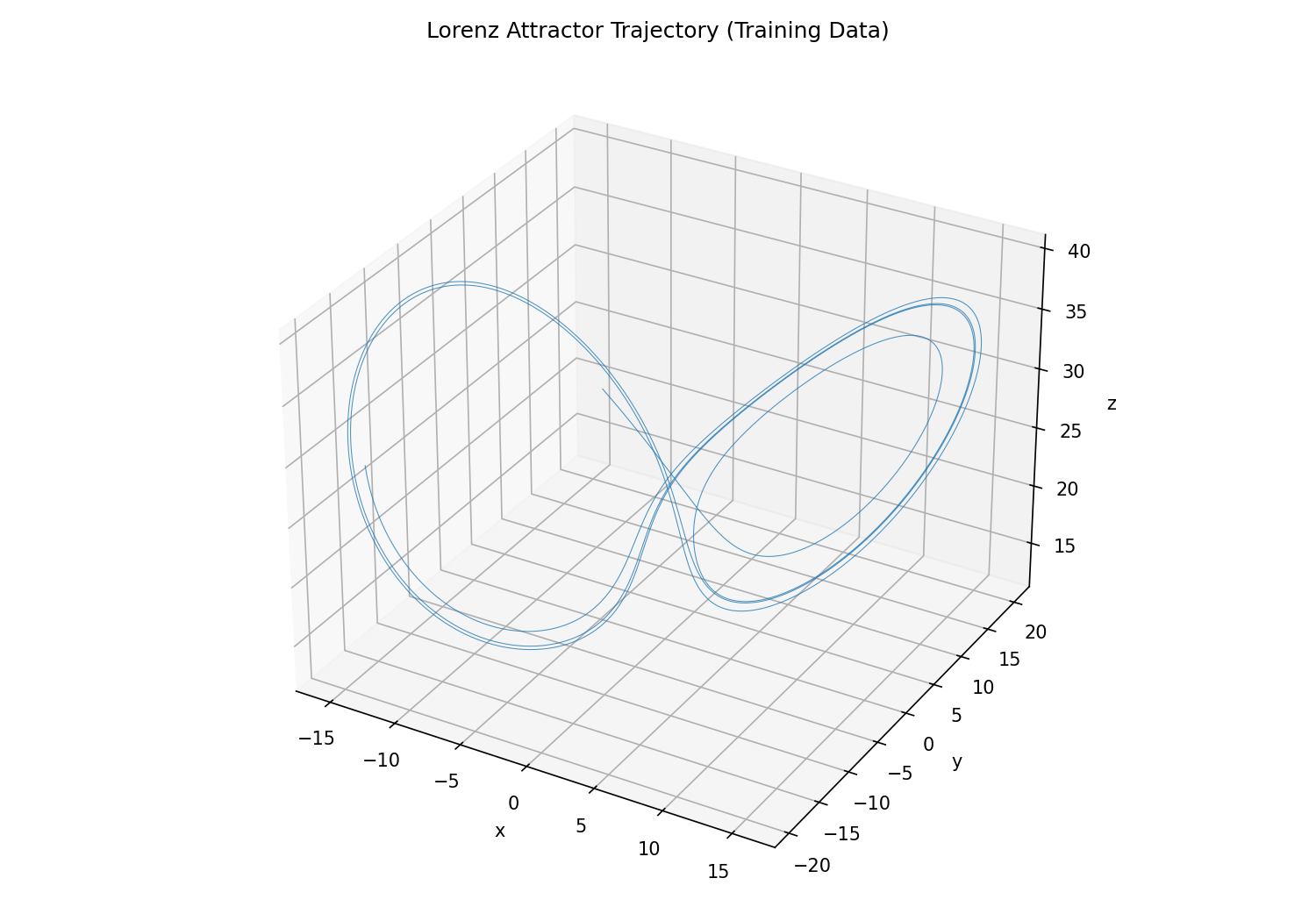
The Lorenz system with \(\sigma = 10\), \(\rho = 28\), \(\beta = 8/3\), integrated for 5000 steps at \(dt = 0.001\).
Lorenz System Recovery
The Lorenz attractor is the canonical test case:
from opifex.discovery.sindy import SINDy, SINDyConfig

config = SINDyConfig(polynomial_degree=2, threshold=0.3)
model = SINDy(config)
model.fit(x_data, x_dot)

for eq in model.equations(["x", "y", "z"]):
    print(eq)
Output:
R² = 1.000000 — exact recovery of the Lorenz system coefficients (\(\sigma = 10\), \(\rho = 28\), \(\beta = 8/3 \approx 2.667\)).
True vs Predicted Derivatives
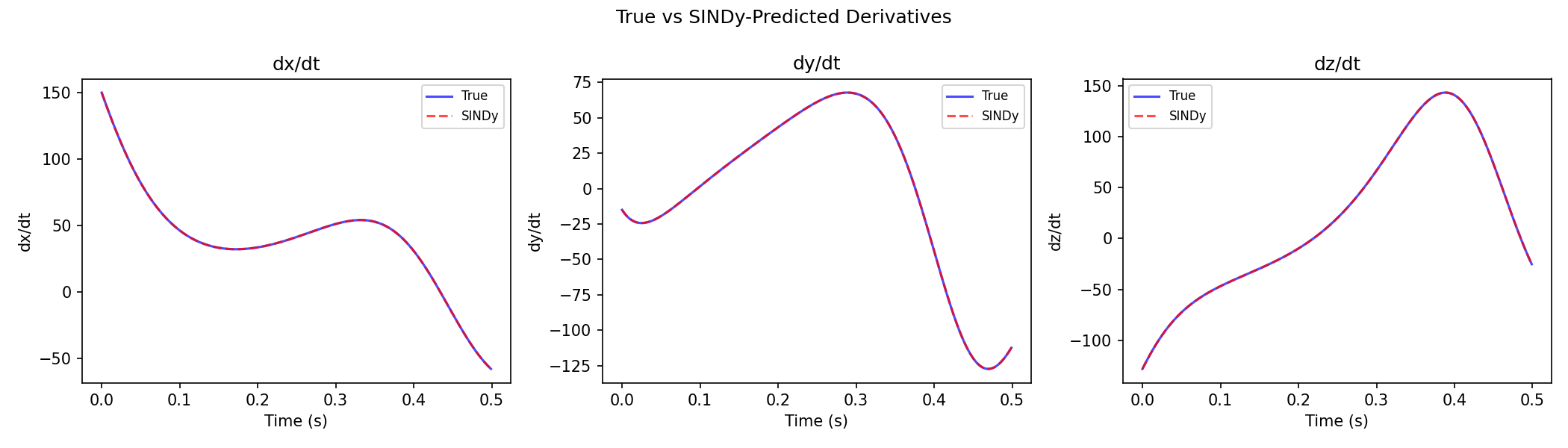
SINDy-predicted derivatives (red dashed) overlay perfectly with the true derivatives (blue solid) across all three state variables.
Sparsity Pattern
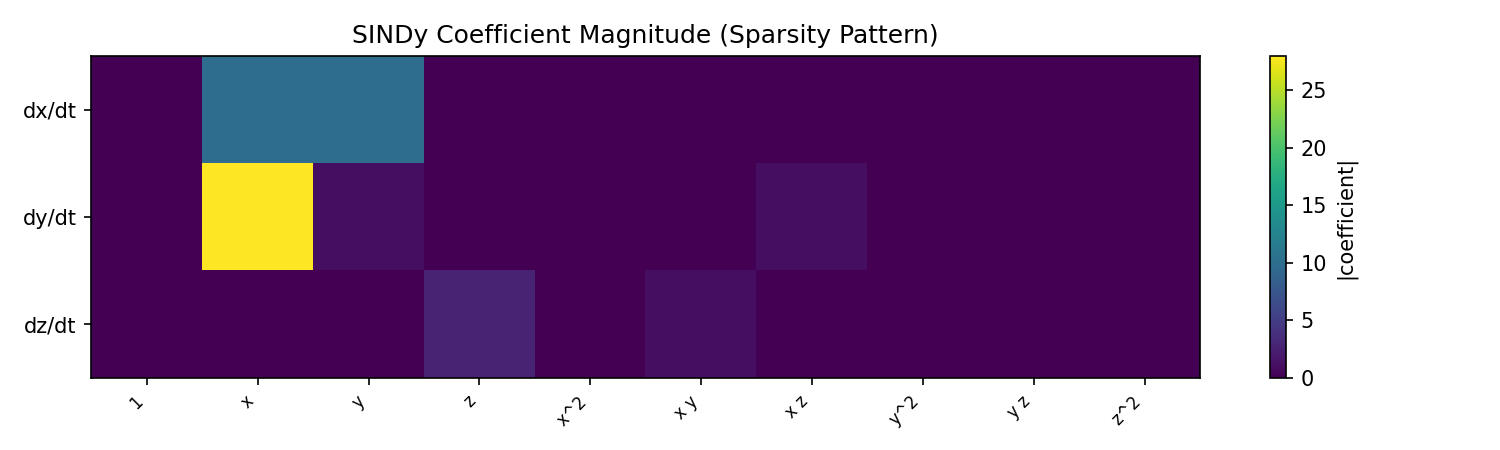
The coefficient matrix shows 7 nonzero terms out of 30 possible (3 equations x 10 library terms), matching the known Lorenz structure.
Optional cross-check against PySINDy
Opifex's SINDy is the subject of this example. As an optional validation, the example also cross-checks against the reference PySINDy library if it is installed — if not, that step is skipped and the example still runs end-to-end on opifex's SINDy. When PySINDy is present, both recover identical equations and R² scores:
=== Opifex SINDy (JAX-native) ===
dx/dt = -10.000 x + 10.000 y
dy/dt = 27.991 x + -0.998 y + -1.000 x z
dz/dt = -2.667 z + 1.000 x y
R² score: 1.000000
=== PySINDy (reference cross-check) ===
(x0)' = -10.000 x0 + 10.000 x1
(x1)' = 28.000 x0 + -1.000 x1 + -1.000 x0 x2
(x2)' = -2.667 x2 + 1.000 x0 x1
R² score: 1.000000
Opifex R² matches PySINDy: True
Both achieve R² = 1.000000. Opifex matches PySINDy's accuracy on the Lorenz benchmark while being pure JAX (JIT-compilable, GPU-acceleratable, differentiable).
Ensemble SINDy for Uncertainty
from opifex.discovery.sindy import EnsembleSINDy
from opifex.discovery.sindy.config import EnsembleSINDyConfig

config = EnsembleSINDyConfig(
    polynomial_degree=2, threshold=0.3,
    n_models=20, bagging_fraction=0.8,
)
ensemble = EnsembleSINDy(config)
ensemble.fit(x_data, x_dot, key=jax.random.PRNGKey(42))
Output:
Ensemble equations (mean +/- std):
  dx/dt = (-10.000+/-0.000) x + (10.000+/-0.000) y
  dy/dt = (28.000+/-0.000) x + (-1.000+/-0.000) y + (-1.000+/-0.000) x z
  dz/dt = (-2.667+/-0.000) z + (1.000+/-0.000) x y

Mean coefficient uncertainty: 0.0000
Max coefficient uncertainty:  0.0002
Near-zero uncertainty on clean data confirms the robustness of the recovery.
Numerical Differentiation
When derivatives are not available analytically:
from opifex.discovery.sindy.utils import finite_difference

x_dot_numerical = finite_difference(x_data, dt)
model.fit(x_data, x_dot_numerical)
Still excellent recovery (R² > 0.9999) even with numerically estimated derivatives.
API Reference
| Class | Description |
|---|---|
SINDy |
Core model: fit, predict, equations, score |
EnsembleSINDy |
Bootstrap aggregation for uncertainty |
CandidateLibrary |
Polynomial, trig, custom basis functions |
STLSQ |
Sequential Thresholded Least Squares optimizer |
SR3 |
Sparse Relaxed Regularized Regression optimizer |
SINDyConfig |
Algorithm configuration (frozen dataclass) |
distill_ude_residual |
UDE neural residual to symbolic equations |
References
- Brunton et al. (2016) "Discovering governing equations from data by sparse identification of nonlinear dynamical systems"
- Fasel et al. (2022) "Ensemble-SINDy: Robust sparse model discovery in the low-data, high-noise limit"
- PySINDy: dynamicslab/pysindy