Heat Equation PINN
| Metadata | Value |
|---|---|
| Level | Intermediate |
| Runtime | ~1 min (GPU) / ~5 min (CPU) |
| Prerequisites | JAX, Flax NNX, basic calculus |
| Format | Python + Jupyter |
| Memory | ~500 MB RAM |
Overview
Physics-Informed Neural Networks (PINNs) solve PDEs by embedding the governing equations directly into the neural network loss function. Instead of learning from labeled input-output pairs, PINNs minimize the PDE residual at collocation points, requiring no simulation data.
This example demonstrates solving the heat equation \(\frac{\partial u}{\partial t} = \alpha \nabla^2 u\) on a 2D rectangular domain using Opifex's PINN infrastructure. It covers problem definition with geometry primitives, model creation, collocation-based training, and loss evaluation.
What You'll Learn
- Define a PDE problem with
create_pde_problemand geometry primitives - Create a PINN model with
create_heat_equation_pinn - Train using Opifex's
Trainerwith collocation points - Evaluate training results and loss convergence
Coming from DeepXDE?
| DeepXDE | Opifex (JAX) |
|---|---|
dde.geometry.Rectangle([0,0], [1,1]) |
Rectangle(center=jnp.array([0.5, 0.5]), width=1.0, height=1.0) |
dde.data.PDE(geom, pde, bc, ...) |
create_pde_problem(geometry=, equation=, boundary_conditions=) |
dde.Model(data, net) |
create_heat_equation_pinn(spatial_dim=2, hidden_dims=[50,50,50], rngs=) |
model.compile("adam", lr=1e-3) |
TrainingConfig(num_epochs=100, learning_rate=1e-3) |
model.train(epochs=10000) |
trainer.fit(train_data=(x, y)) |
dde.grad.jacobian(y, x, i=0, j=0) |
jax.grad(u_fn, argnums=0)(x, t) |
Key difference: Opifex uses JAX's automatic differentiation directly (jax.grad,
jax.hessian), which is more composable than DeepXDE's gradient API. PDE residuals
are computed as pure functions, enabling JIT compilation of the entire training loop.
Files
- Python Script:
examples/pinns/heat_equation.py - Jupyter Notebook:
examples/pinns/heat_equation.ipynb
Quick Start
Run the Python Script
Run the Jupyter Notebook
Core Concepts
How PINNs Work
PINNs replace traditional PDE solvers by training a neural network to satisfy the governing equation. The loss function has three components:
graph TB
    A["Collocation Points<br/>(random in domain)"] --> B["Neural Network<br/>u_theta(x, t)"]
    B --> C["PDE Residual Loss<br/>|du/dt - alpha * laplacian(u)|^2"]
    B --> D["Boundary Loss<br/>|u(x_boundary) - g(x)|^2"]
    B --> E["Initial Condition Loss<br/>|u(x, 0) - u_0(x)|^2"]
    C --> F["Total Loss"]
    D --> F
    E --> F

    style A fill:#e3f2fd
    style F fill:#c8e6c9
Heat Equation
The heat equation models diffusion processes:
where \(\alpha\) is the thermal diffusivity and \(u(x,t)\) is the temperature field.
| Component | This Example |
|---|---|
| Domain | \([0,1] \times [0,1]\) rectangle |
| Boundary | Dirichlet: \(u = 0\) on all boundaries |
| Diffusivity | \(\alpha = 0.01\) |
| Architecture | MultiScalePINN with 3 scale networks of 50 units |
Implementation
Step 1: Define the PDE Problem
Use Opifex geometry primitives and problem definition:
from opifex.geometry import Rectangle
from opifex.core.problems import create_pde_problem

geometry = Rectangle(center=jax.numpy.array([0.5, 0.5]), width=1.0, height=1.0)

problem = create_pde_problem(
    geometry=geometry,
    equation=lambda x, u, u_x: 0.0,
    boundary_conditions=[{"type": "dirichlet", "boundary": "all", "value": 0.0}],
    parameters={"diffusivity": 0.01},
)
Step 2: Create the PINN Model
from opifex.neural.pinns import create_heat_equation_pinn

rngs = nnx.Rngs(42)
pinn = create_heat_equation_pinn(
    spatial_dim=2,
    hidden_dims=[50, 50, 50],
    rngs=rngs,
)
Step 3: Configure Training
from opifex.core.training.config import TrainingConfig
from opifex.core.training.trainer import Trainer

config = TrainingConfig(
    num_epochs=100,
    learning_rate=1e-3,
    batch_size=256,
)

trainer = Trainer(model=pinn, config=config)
Step 4: Generate Collocation Points and Train
key = jax.random.PRNGKey(42)
x = jax.random.uniform(key, (1000, 3))  # (x, y, t)
y = jax.numpy.zeros((1000, 1))          # Target: residual = 0

trainer.fit(train_data=(x, y))
Visualization
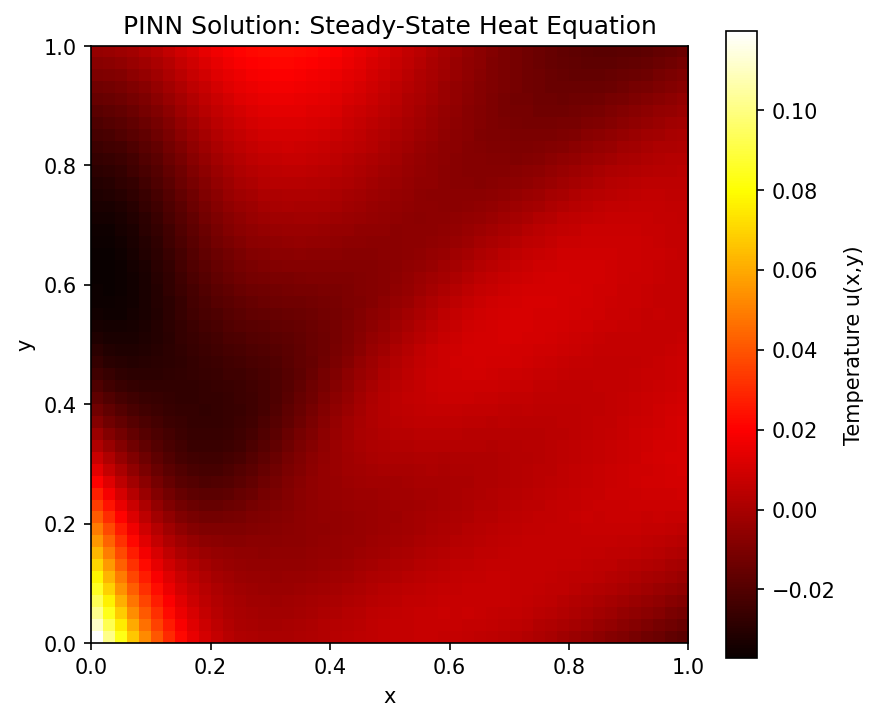
The trained PINN's temperature field on the evaluation grid:
Results Summary
| Metric | Value |
|---|---|
| Domain | \([0,1] \times [0,1]\) |
| PINN Architecture | [50, 50, 50] |
| Training Epochs | 100 |
| Learning Rate | 1e-3 |
| Batch Size | 256 |
| Diffusivity | 0.01 |
Key Takeaways
- PINNs solve PDEs without simulation data by minimizing physics residuals
- Opifex provides factory functions for common PDE types (
create_heat_equation_pinn) - JAX's
gradandhessianenable efficient PDE residual computation - The
Trainerhandles optimization, while collocation points serve as "data" - For better accuracy, increase epochs to 1000+ and use more collocation points
Next Steps
Experiments to Try
- More epochs: Train for 1000-10000 epochs to observe convergence
- Larger network: Try
hidden_dims=[100, 100, 100, 100]for higher accuracy - Time-dependent: Add time dimension for transient heat equation
- Adaptive sampling: Concentrate collocation points near boundaries
Related Examples
| Example | Level | What You'll Learn |
|---|---|---|
| Domain Decomposition PINNs | Advanced | Scale PINNs to large domains |
| FNO Darcy Full | Intermediate | Data-driven alternative to PINNs |
| Enhanced Calibration | Advanced | Uncertainty quantification for predictions |
API Reference
create_pde_problem- PDE problem definition factorycreate_heat_equation_pinn- Heat equation PINN factoryRectangle- 2D rectangular geometryTrainer- Training orchestrationTrainingConfig- Training hyperparameters
Troubleshooting
Loss not decreasing
Symptom: Training loss stays flat after many epochs.
Cause: Learning rate too low, or insufficient collocation points.
Solution: Increase learning rate to 1e-2 for initial training, then reduce. Use at least 1000 collocation points for a 2D domain:
PINN predicts zero everywhere
Symptom: All predictions are approximately zero.
Cause: Boundary loss dominates, pushing the solution to the trivial solution.
Solution: Balance loss components. Use adaptive loss weighting:
# Weight physics loss higher than boundary loss
total_loss = 10.0 * physics_loss + 1.0 * boundary_loss
Slow training on CPU
Symptom: Each epoch takes seconds instead of milliseconds.
Cause: No JIT compilation, or small batch sizes preventing vectorization.
Solution: Ensure JIT compilation is active (it is by default with Opifex's Trainer). Use batch sizes of 256+ for efficient vectorization.