XPINN: Extended PINN on Viscous Burgers Equation
Filename Note
The filename xpinn-helmholtz is a historical artifact. This example solves the
viscous Burgers equation, not the Helmholtz equation.
| Metadata | Value |
|---|---|
| Level | Intermediate |
| Runtime | ~2 min (GPU) / ~12 min (CPU) |
| Prerequisites | JAX, Flax NNX, PDEs |
| Format | Python + Jupyter |
| Memory | ~400 MB RAM |
Overview
This example demonstrates solving the 1D viscous Burgers equation using XPINN (Extended Physics-Informed Neural Network). XPINNs use non-overlapping subdomains with explicit interface conditions for continuity and flux matching.
Unlike FBPINNs which use smooth window blending, XPINNs enforce interface conditions through additional loss terms. This makes XPINNs suitable for problems where sharp interfaces or discontinuities need to be captured.
What You'll Learn
- Understand the XPINN architecture with non-overlapping subdomains
- Implement interface continuity and flux matching conditions
- Configure loss weights for interface enforcement
- Use Opifex's XPINN class for domain decomposition
- Visualize interface discontinuity and solution quality
Coming from XPINNs Literature?
| XPINNs (Literature) | Opifex (JAX) |
|---|---|
| Separate networks per subdomain | XPINN class with SubdomainNetwork list |
| Interface continuity loss | model.compute_continuity_loss() |
| Flux matching loss | model.compute_flux_loss() |
| Weighted loss combination | XPINNConfig(continuity_weight=..., flux_weight=...) |
Key differences:
- Built-in methods: Interface losses computed via class methods
- JIT-compatible: All interface computations are JAX-compatible
- Configurable weights: Easy weight adjustment via config
Files
- Python Script:
examples/domain-decomposition/xpinn_helmholtz.py - Jupyter Notebook:
examples/domain-decomposition/xpinn_helmholtz.ipynb
Quick Start
Run the Python Script
Run the Jupyter Notebook
Core Concepts
XPINN Architecture
XPINNs decompose the domain into non-overlapping subdomains:
At interfaces, we enforce: - Continuity: \(u_{left} = u_{right}\) - Flux matching: \(\frac{\partial u}{\partial n}_{left} = \frac{\partial u}{\partial n}_{right}\)
| Component | This Example |
|---|---|
| Domain | \(x \in [-1, 1]\), \(t \in [0, 1]\) |
| Subdomains | 2 (split at \(x = 0\)) |
| Interface | Vertical line at \(x = 0\) |
| PDE | Viscous Burgers equation |
| Viscosity | \(\nu = 0.01/\pi\) |
Viscous Burgers Equation
With: - IC: \(u(x, 0) = -\sin(\pi x)\) - BC: \(u(-1, t) = u(1, t) = 0\)
Implementation
Step 1: Imports and Configuration
Terminal Output:
======================================================================
Opifex Example: XPINN on 1D Viscous Burgers Equation
======================================================================
JAX backend: gpu
JAX devices: [CudaDevice(id=0)]

Viscous Burgers: du/dt + u*du/dx = nu*d^2u/dx^2
  Viscosity: nu = 0.01/pi ~ 0.003183
Domain: x in [-1.0, 1.0], t in [0.0, 1.0]
Subdomains: 2
Network per subdomain: [2] + [40, 40, 40] + [1]
Training: 15000 epochs @ lr=0.001
Step 2: Define Subdomains and Interfaces
# Non-overlapping subdomains
subdomains = [
    Subdomain(id=0, bounds=jnp.array([[-1.0, 0.0], [0.0, 1.0]])),  # Left
    Subdomain(id=1, bounds=jnp.array([[0.0, 1.0], [0.0, 1.0]])),   # Right
]

# Interface at x = 0
interface_points = jnp.column_stack([
    jnp.zeros(N_INTERFACE),
    jnp.linspace(0.0, 1.0, N_INTERFACE),
])

interfaces = [
    Interface(
        subdomain_ids=(0, 1),
        points=interface_points,
        normal=jnp.array([1.0, 0.0]),
    )
]
Terminal Output:
Step 3: Configure XPINN
xpinn_config = XPINNConfig(
    continuity_weight=10.0,  # u_left = u_right
    flux_weight=10.0,        # du/dx_left = du/dx_right
    residual_weight=1.0,     # PDE residual
)

model = XPINN(
    input_dim=2, output_dim=1,
    subdomains=subdomains,
    interfaces=interfaces,
    hidden_dims=[40, 40, 40],
    config=xpinn_config,
    rngs=nnx.Rngs(42),
)
Step 4: Training with Interface Conditions
Terminal Output:
Training XPINN...
  Epoch     1/15000: loss=2.217746e+01, continuity=1.131944e-02, flux=5.758483e-01
  Epoch  3000/15000: loss=2.154962e-01, continuity=8.435045e-05, flux=5.011343e-04
  Epoch  6000/15000: loss=2.030331e-01, continuity=1.473404e-04, flux=7.426925e-04
  Epoch  9000/15000: loss=1.890347e-01, continuity=7.456433e-05, flux=2.159171e-05
  Epoch 12000/15000: loss=1.837308e-01, continuity=8.042133e-05, flux=4.365924e-05
  Epoch 15000/15000: loss=1.795815e-01, continuity=5.910662e-05, flux=1.106780e-04
Final loss: 1.795815e-01
Step 5: Evaluation
Terminal Output:
Evaluating XPINN...
IC error (mean abs):     4.116559e-02
BC error (mean abs):     1.945176e-03
Interface jump:          5.408616e-03
Visualization
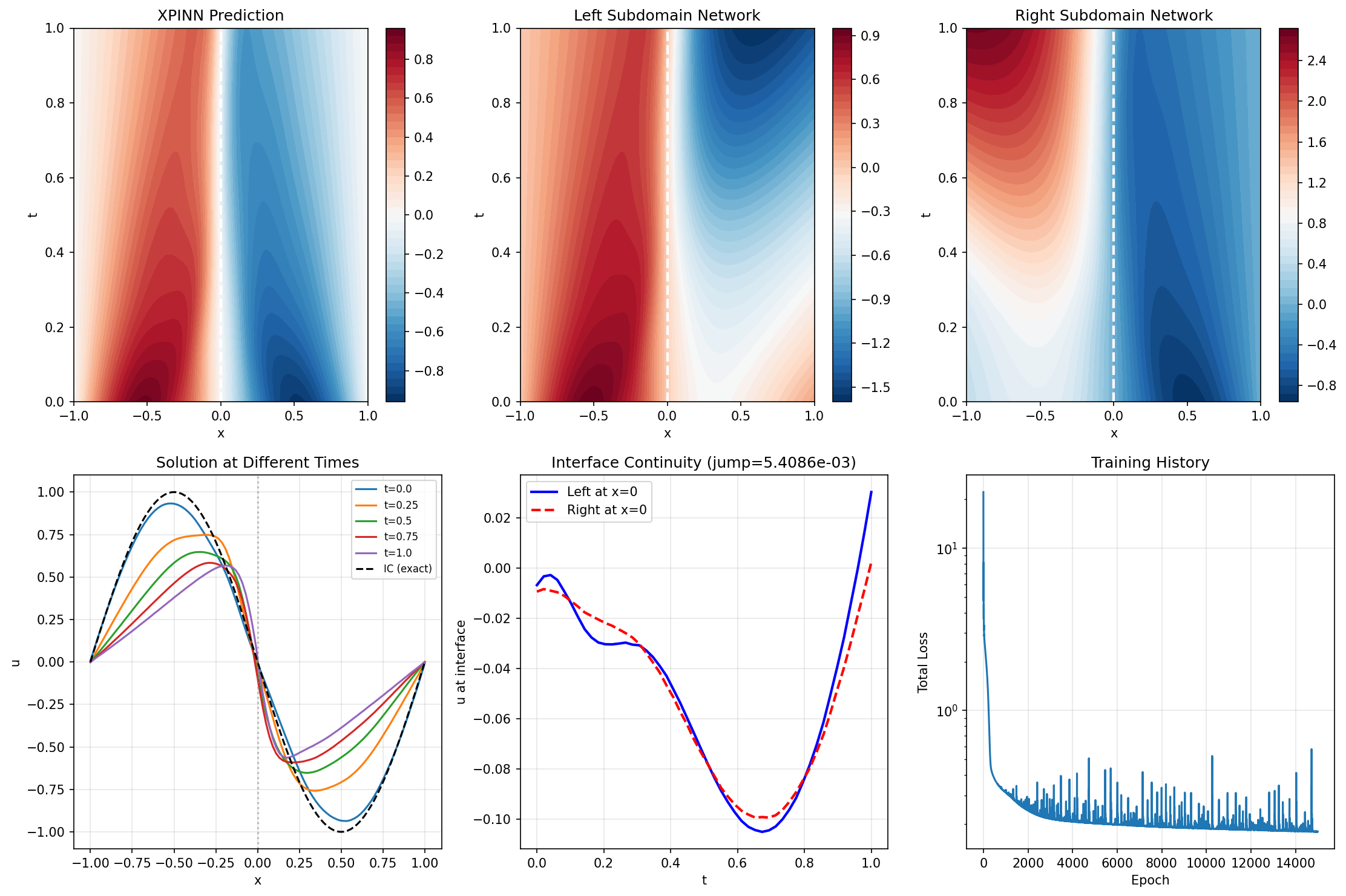
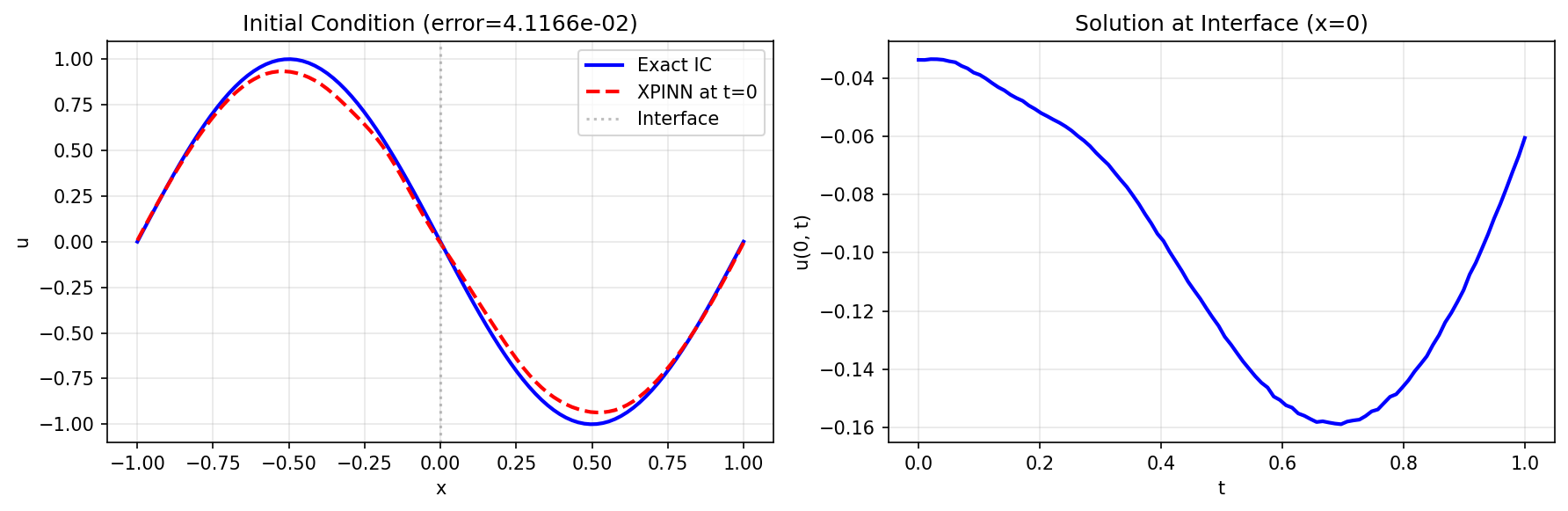
Results Summary
| Metric | Value |
|---|---|
| Final Loss | 0.18 |
| IC Error | 4.12e-02 |
| BC Error | 1.95e-03 |
| Interface Jump | 5.41e-03 |
| Continuity Loss | 5.91e-05 |
| Flux Loss | 1.11e-04 |
| Parameters | 6,882 |
| Training Epochs | 15,000 |
Next Steps
Experiments to Try
- More subdomains: Split into 4 or 8 subdomains
- Higher viscosity: Try \(\nu = 0.1\) for smoother solutions
- Longer time: Extend to \(t \in [0, 2]\) to see shock formation
- Residual averaging: Enable
average_residual_weightfor interface
Related Examples
| Example | Level | What You'll Learn |
|---|---|---|
| FBPINN on Harmonic Oscillator | Intermediate | Overlapping subdomains |
| CPINN on Advection | Intermediate | Flux conservation |
| Burgers PINN | Intermediate | Single-domain PINN |
API Reference
XPINN: XPINN class with interface conditionsXPINNConfig: Configuration (weights for losses)Interface: Interface definition with points and normalcompute_continuity_loss(): Solution continuity at interfacescompute_flux_loss(): Gradient continuity at interfaces
Troubleshooting
| Issue | Solution |
|---|---|
| Large interface jump | Increase continuity_weight |
| Flux discontinuity | Increase flux_weight |
| Solution mismatch at t=0 | Check IC loss weighting |
| Slow convergence | Adjust interface loss weights |