Residual-based Adaptive Sampling for PINNs
| Level | Runtime | Prerequisites | Format | Memory |
|---|---|---|---|---|
| Advanced | ~3 min | PINN basics | Tutorial | ~500 MB |
Overview
This example demonstrates Residual-based Adaptive Refinement (RAR-D) for more efficient PINN training. RAR-D concentrates collocation points in regions with high PDE residual, focusing computational effort where it's needed most.
SciML Context: PINNs with uniform collocation point distributions often struggle with solutions that have localized features (sharp gradients, boundary layers, shocks). Adaptive sampling automatically identifies and refines these regions.
Reference: Residual-based Adaptive Refinement (RAR) algorithm (Lu et al., 2021).
What You'll Learn
- Understand why uniform sampling can be inefficient
- Implement RAR-D refinement with
RARDRefiner - Use RAR-D for progressive point refinement with
RARDRefiner - Compare adaptive vs uniform sampling performance
- Visualize collocation point distribution evolution
Coming from DeepXDE?
| DeepXDE | Opifex |
|---|---|
data.add_anchors(X[x_id]) |
RARDRefiner.refine(points, residuals, bounds, key) |
dde.callbacks.PDEPointResampler |
RARDRefiner.refine(points, residuals, bounds, key) |
np.argmax(err_eq) |
compute_sampling_distribution(residuals, beta=1.0) |
Files
- Python script:
examples/advanced-training/adaptive_sampling.py - Jupyter notebook:
examples/advanced-training/adaptive_sampling.ipynb
Quick Start
Run the script
Run the notebook
Core Concepts
Why Adaptive Sampling?
For solutions with localized features (e.g., Burgers equation shock):
| Sampling | Points | Accuracy |
|---|---|---|
| Uniform | Many wasted in smooth regions | Poor near sharp gradients |
| Adaptive | Concentrated near high residual | Better overall accuracy |
RAR-D Algorithm
Residual-based Adaptive Distribution samples with probability:
Where: - \(r_j\) = PDE residual at point \(j\) - \(\beta\) = concentration parameter
graph TD
    A[Compute PDE Residuals] --> B[Calculate Sampling Probabilities]
    B --> C{Refine or Resample?}
    C -->|Refine| D[Add Points Near High Residual]
    C -->|Resample| E[Draw New Batch from Distribution]
    D --> F[Continue Training]
    E --> F
    F --> A
RAR-D: Adaptive Refinement
RAR-D adds new points near high-residual regions:
- Identify points with residual above threshold (e.g., 90th percentile)
- Sample base points with residual-weighted probability
- Add random perturbation
- Clip to domain bounds
- Append to training set
Implementation
Step 1: Setup Adaptive Sampling
from opifex.core.training.components.adaptive_sampling import (
    RARDConfig,
    RARDRefiner,
)

rard_config = RARDConfig(
    num_new_points=25,
    percentile_threshold=90.0,  # focus refinement on the top 10% residual region
    noise_scale=0.1,
)
refiner = RARDRefiner(rard_config)
Terminal Output:
Step 2: Training with Periodic Refinement
for step in range(TRAINING_STEPS):
    # Train on current points
    loss, grads = nnx.value_and_grad(loss_fn)(pinn)
    opt.update(pinn, grads)

    # Periodic refinement
    if step > 0 and step % REFINE_FREQUENCY == 0:
        # Compute residuals at current points
        residuals = compute_burgers_residual(pinn, xt_current, NU)

        # Add new points near high-residual regions
        xt_current = refiner.refine(xt_current, residuals, bounds, key)
Terminal Output:
Training PINN with adaptive sampling...
--------------------------------------------------
  Step  200: loss=9.168496e-01, points=125, max_res=1.5502e+00
  Step  400: loss=6.883082e-01, points=150, max_res=1.0713e+00
  Step  600: loss=1.955346e-01, points=175, max_res=5.9579e-01
  Step  800: loss=3.781535e-02, points=200, max_res=6.6150e-01
  Final: loss=2.236790e-02, points=200
Step 3: Compare with Uniform Sampling
# Fixed uniform points for baseline
xt_uniform = random_uniform_points(N_UNIFORM_POINTS)

for step in range(TRAINING_STEPS):
    loss = train_step_uniform(pinn, opt)
Terminal Output:
Training PINN with uniform sampling (baseline)...
--------------------------------------------------
  Step    0: loss=1.424544e+01
  Step  200: loss=9.168183e-01
  Step  400: loss=6.857803e-01
  Step  600: loss=2.191314e-01
  Step  800: loss=4.407514e-02
  Final: loss=2.650756e-02
Step 4: Compare solution accuracy against a spectral reference
Comparing each method's training loss is unfair — adaptive deliberately concentrates points
where the residual is hardest, so its training loss need not be lower even when its solution is
more accurate. Both PINNs solve the same periodic Burgers problem, so we score each against a
high-resolution spectral reference (solve_burgers_spectral) on a common grid:
Evaluating solution accuracy against a spectral reference...
  Adaptive solution relative L2: 0.0749
  Uniform  solution relative L2: 0.0821
  Adaptive reduces the solution error by 9% vs uniform
Visualization
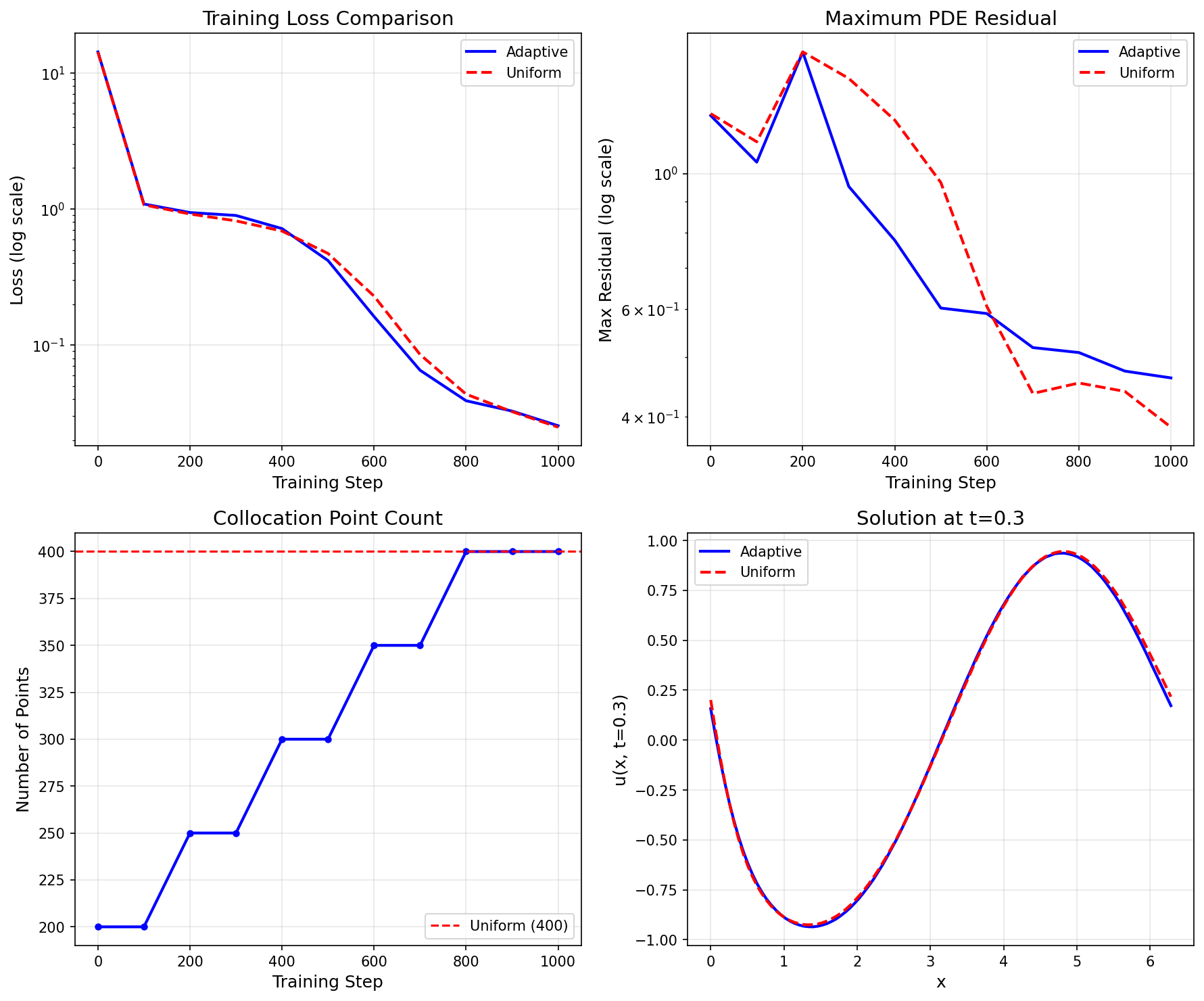
Training Comparison
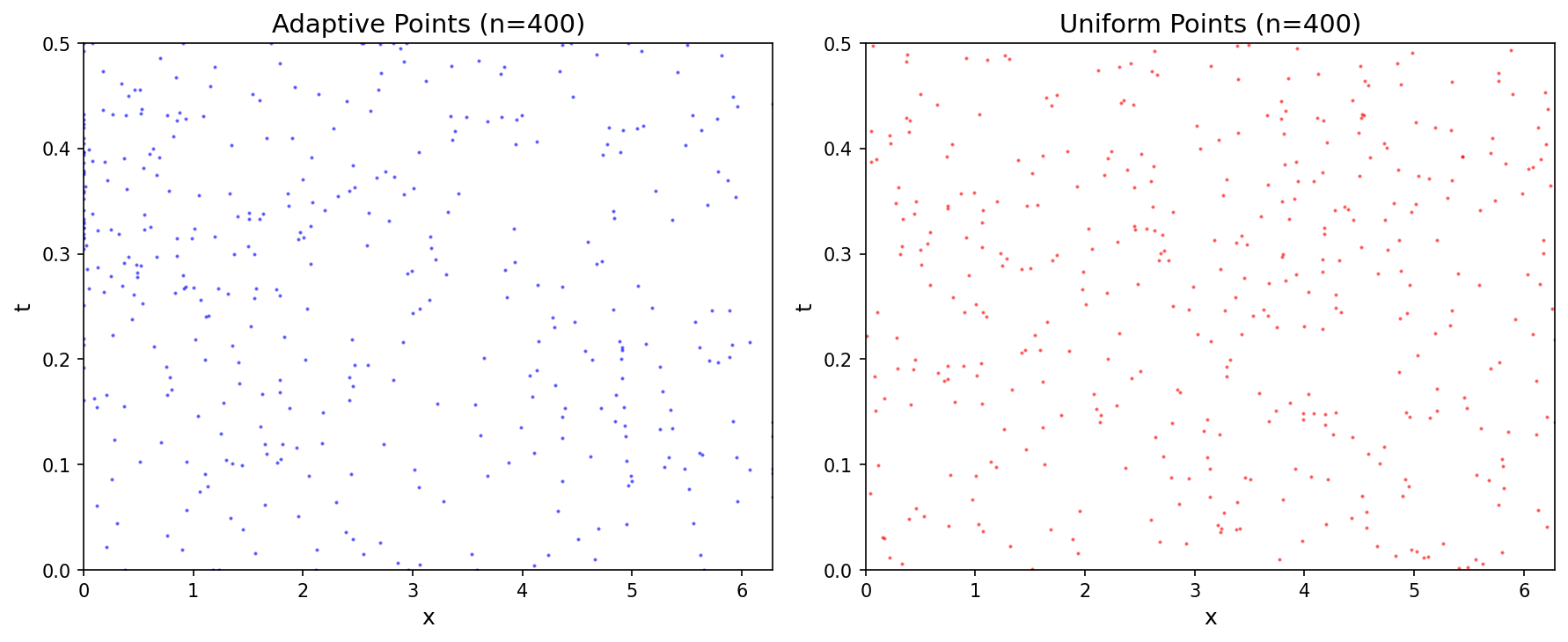
Point Distribution
Results Summary
Both methods use the same total collocation budget (200 points); only the placement differs. Accuracy is measured against the spectral reference solution, not the training loss.
| Method | Final Points | Solution Relative L2 |
|---|---|---|
| Adaptive (RAR-D) | 200 | 0.0749 |
| Uniform | 200 | 0.0821 |
Key Observations:
- At a tight point budget, adaptive RAR-D reduces the solution error by ~9% over uniform with the same number of points — it concentrates the scarce points on the steep travelling front where uniform sampling under-resolves.
- The meaningful comparison is solution error against a reference, not training loss on each method's own (different) collocation points.
- The advantage grows when points are scarce relative to the localized feature; with a very dense uniform grid the gap shrinks.
Next Steps
Experiments to Try
- Increase refinement: Add more points per step
- Lower beta: Smoother probability distribution (beta < 1)
- Higher beta: Sharper focus on max residual (beta > 1)
- Sharper shocks: Reduce viscosity to see adaptive benefit
Related Examples
- NTK Analysis - Diagnose training dynamics
- GradNorm - Balance loss components
- Burgers PINN - Basic Burgers equation
API Reference
Troubleshooting
Points clustering too tightly
- Increase
noise_scalein RARDConfig - Lower
percentile_thresholdto spread refinement - Lower
betafor smoother probability distribution
Not enough refinement
- Increase
num_new_points - Decrease
refine_frequency - Raise
percentile_thresholdto be more selective
Points leaving domain
- Check bounds are correct:
bounds = jnp.array([[x_min, x_max], [t_min, t_max]]) - Refinement clips to bounds automatically
Memory growing too fast
- Cap maximum number of points
- Tune
percentile_threshold/num_new_pointsto trade concentration vs coverage - Consider periodic pruning of low-residual points