Diffusion-Reaction Equation PINN
| Metadata | Value |
|---|---|
| Level | Intermediate |
| Runtime | ~3 min (GPU) / ~12 min (CPU) |
| Prerequisites | JAX, Flax NNX, PDEs |
| Format | Python + Jupyter |
| Memory | ~500 MB RAM |
Overview
This tutorial demonstrates solving a diffusion-reaction equation using a PINN. The problem features multiple frequency components (sine waves) that the network must learn simultaneously, making it a good test for spectral approximation.
The equation models phenomena where diffusion and source/reaction terms compete, such as heat transfer with internal heat generation or chemical diffusion with reaction kinetics.
What You'll Learn
- Implement a PINN for diffusion-reaction PDEs
- Apply hard constraints for multi-frequency initial conditions
- Handle manufactured solutions with complex source terms
- Understand how networks learn multiple frequency components
Coming from DeepXDE?
| DeepXDE | Opifex (JAX) |
|---|---|
dde.geometry.Interval(-np.pi, np.pi) |
jnp.linspace(-jnp.pi, jnp.pi, N) |
net.apply_output_transform(transform) |
Hard constraint in __call__ method |
dde.nn.FNN([2] + [30]*6 + [1]) |
nnx.Linear layers with tanh activation |
model.train(iterations=20000) |
15000 epochs with Adam optimizer |
Key differences:
- Hard constraint:
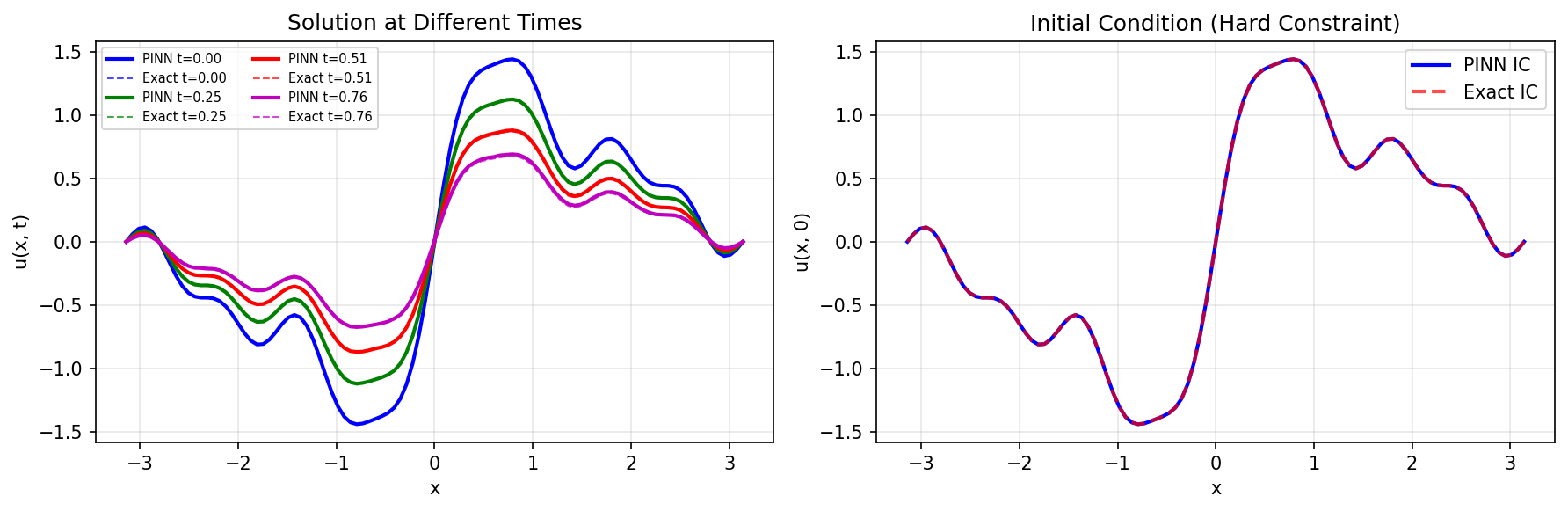
u = t*(pi^2 - x^2)*u_hat + IC(x)enforces IC and BC - Source term: Computed analytically from manufactured solution
- Multi-frequency IC: Sum of sin(kx)/k terms with k = 1, 2, 3, 4, 8
Files
- Python Script:
examples/pinns/diffusion_reaction.py - Jupyter Notebook:
examples/pinns/diffusion_reaction.ipynb
Quick Start
Run the Python Script
Run the Jupyter Notebook
Core Concepts
Diffusion-Reaction Equation
\[\frac{\partial u}{\partial t} = D \frac{\partial^2 u}{\partial x^2} + f(x, t)\]
| Component | This Example |
|---|---|
| Domain | \(x \in [-\pi, \pi]\), \(t \in [0, 1]\) |
| Diffusion | \(D = 1\) |
| Solution | \(u = e^{-t}(\sin x + \frac{\sin 2x}{2} + \frac{\sin 3x}{3} + \frac{\sin 4x}{4} + \frac{\sin 8x}{8})\) |
| IC | Sum of sine waves at \(t=0\) |
| BC | \(u(\pm\pi, t) = 0\) (Dirichlet) |
Physical Interpretation
- Diffusion: Smooths spatial gradients
- Source term: Chosen to maintain the multi-frequency structure
- Exponential decay: All frequency components decay at the same rate
Implementation
Step 1: Imports and Configuration
Terminal Output:
======================================================================
Opifex Example: Diffusion-Reaction Equation PINN
======================================================================
JAX backend: gpu
JAX devices: [CudaDevice(id=0)]

Diffusion coefficient: D = 1.0
Domain: x in [-3.1416, 3.1416], t in [0.0, 1.0]
Collocation: 2000 domain, 100 boundary, 200 initial
Network: [2] + [30, 30, 30, 30, 30, 30] + [1]
Training: 15000 epochs @ lr=0.001
Step 2: Define the Problem
D = 1.0  # Diffusion coefficient

def exact_solution(x, t):
    """Exact solution: sum of sine waves with exponential decay."""
    return jnp.exp(-t) * (
        jnp.sin(x) + jnp.sin(2*x)/2 + jnp.sin(3*x)/3
        + jnp.sin(4*x)/4 + jnp.sin(8*x)/8
    )

def source_term(x, t):
    """Source term f(x, t) for the manufactured solution."""
    return jnp.exp(-t) * (
        3*jnp.sin(2*x)/2 + 8*jnp.sin(3*x)/3
        + 15*jnp.sin(4*x)/4 + 63*jnp.sin(8*x)/8
    )
Terminal Output:
Diffusion-reaction: du/dt = D*d^2u/dx^2 + f(x,t)
  Diffusion: D = 1.0
  Solution: sum of sin(kx)/k terms with exp(-t) decay
  BC: u(-pi, t) = u(pi, t) = 0 (periodic-like)
  IC: u(x, 0) = sin(x) + sin(2x)/2 + ...
Step 3: Create PINN with Hard Constraint
class DiffusionReactionPINN(nnx.Module):
    def __init__(self, hidden_dims: list[int], *, rngs: nnx.Rngs):
        super().__init__()
        layers = []
        in_features = 2  # (x, t)

        for hidden_dim in hidden_dims:
            layers.append(nnx.Linear(in_features, hidden_dim, rngs=rngs))
            in_features = hidden_dim

        layers.append(nnx.Linear(in_features, 1, rngs=rngs))
        self.layers = nnx.List(layers)

    def __call__(self, xt: jax.Array) -> jax.Array:
        """Forward pass with hard constraint for IC and BC."""
        x, t = xt[:, 0:1], xt[:, 1:2]

        # Network output
        h = xt
        for layer in self.layers[:-1]:
            h = jnp.tanh(layer(h))
        u_hat = self.layers[-1](h)

        # Hard constraint: u = t*(pi^2 - x^2)*u_hat + IC(x)
        ic_term = (jnp.sin(x) + jnp.sin(2*x)/2 + jnp.sin(3*x)/3
                   + jnp.sin(4*x)/4 + jnp.sin(8*x)/8)
        bc_mask = t * (jnp.pi**2 - x**2)

        return bc_mask * u_hat + ic_term

pinn = DiffusionReactionPINN(hidden_dims=[30]*6, rngs=nnx.Rngs(42))
Terminal Output:
Step 4: Generate Collocation Points
key = jax.random.PRNGKey(42)
keys = jax.random.split(key, 4)

# Domain interior points
x_domain = jax.random.uniform(keys[0], (N_DOMAIN,), minval=X_MIN, maxval=X_MAX)
t_domain = jax.random.uniform(keys[1], (N_DOMAIN,), minval=T_MIN, maxval=T_MAX)
xt_domain = jnp.column_stack([x_domain, t_domain])
Terminal Output:
Step 5: Define Physics-Informed Loss
def compute_pde_residual(pinn, xt):
    """Compute diffusion-reaction PDE residual."""

    def u_scalar(xt_single):
        return pinn(xt_single.reshape(1, 2)).squeeze()

    def residual_single(xt_single):
        x, t = xt_single[0], xt_single[1]

        grad_u = jax.grad(u_scalar)(xt_single)
        u_t = grad_u[1]

        hess = jax.hessian(u_scalar)(xt_single)
        u_xx = hess[0, 0]

        f = source_term(x, t)

        # Residual: u_t - D*u_xx - f = 0
        return u_t - D * u_xx - f

    return jax.vmap(residual_single)(xt)

def pde_loss(pinn, xt):
    residual = compute_pde_residual(pinn, xt)
    return jnp.mean(residual**2)
Step 6: Training
opt = nnx.Optimizer(pinn, optax.adam(LEARNING_RATE), wrt=nnx.Param)

@nnx.jit
def train_step(pinn, opt, xt_dom):
    def loss_fn(model):
        return pde_loss(model, xt_dom)

    loss, grads = nnx.value_and_grad(loss_fn)(pinn)
    opt.update(pinn, grads)
    return loss

for epoch in range(EPOCHS):
    loss = train_step(pinn, opt, xt_domain)
Terminal Output:
Training PINN...
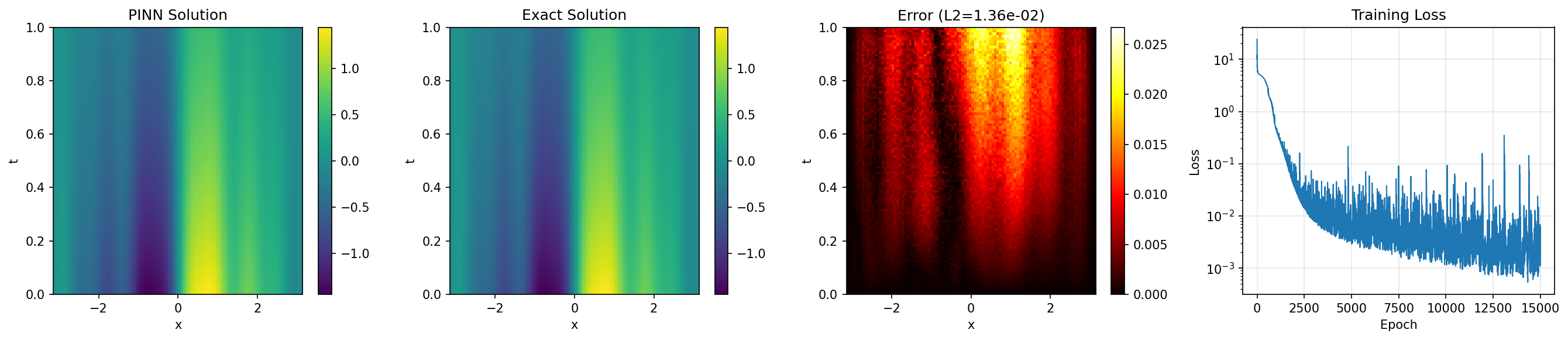
  Epoch     1/15000: loss=2.404716e+01
  Epoch  3000/15000: loss=8.812878e-03
  Epoch  6000/15000: loss=4.998077e-03
  Epoch  9000/15000: loss=7.960054e-03
  Epoch 12000/15000: loss=1.765104e-03
  Epoch 15000/15000: loss=5.911256e-03
Final loss: 5.911256e-03
Step 7: Evaluation
Terminal Output:
Evaluating PINN...
Relative L2 error:   1.364888e-02
Maximum point error: 2.670667e-02
Mean point error:    5.508810e-03
Mean PDE residual:   5.571126e-02
IC error (hard):     0.000000e+00
Visualization
Results Summary
| Metric | Value |
|---|---|
| Final Loss | 5.91e-03 |
| Relative L2 Error | 1.36% |
| Maximum Error | 2.67e-02 |
| Mean PDE Residual | 5.57e-02 |
| IC Error (hard) | 0.0 |
| Parameters | 4,771 |
| Training Epochs | 15,000 |
Next Steps
Experiments to Try
- Fewer frequencies: Remove higher frequency terms to see easier convergence
- More epochs: Train for 30000+ epochs to reduce residual
- Larger network: Try
[40]*8for better frequency resolution - Different decay: Modify source term for non-uniform decay rates
Related Examples
| Example | Level | What You'll Learn |
|---|---|---|
| Heat Equation | Beginner | Simpler diffusion (no reaction) |
| Allen-Cahn | Advanced | Nonlinear reaction term |
| Helmholtz | Intermediate | Multi-frequency with sin act |
Troubleshooting
| Issue | Solution |
|---|---|
| High frequency not captured | Increase network depth or width |
| IC not exact | Check hard constraint formula matches exact IC |
| Slow convergence | Try learning rate scheduling |
| Loss oscillates | Reduce learning rate or add more collocation points |