CPINN: Conservative PINN on Advection-Diffusion Equation
| Metadata | Value |
|---|---|
| Level | Intermediate |
| Runtime | ~2 min (GPU) / ~12 min (CPU) |
| Prerequisites | JAX, Flax NNX, Conservation Laws |
| Format | Python + Jupyter |
| Memory | ~400 MB RAM |
Overview
This example demonstrates solving the 1D advection-diffusion equation using CPINN (Conservative Physics-Informed Neural Network). CPINNs extend XPINNs with explicit flux conservation at subdomain interfaces, critical for conservation laws.
Conservation is enforced by matching the normal flux across interfaces: \(F_{left} \cdot n = F_{right} \cdot n\) where \(F = \nabla u\).
What You'll Learn
- Understand flux conservation in domain decomposition
- Implement conservative interface conditions
- Configure CPINN with 3 subdomains
- Use Opifex's CPINN class for conservation laws
- Analyze interface flux jumps for conservation verification
Coming from Conservation Laws Literature?
| Conservation PINNs (Literature) | Opifex (JAX) |
|---|---|
| Flux computation at interfaces | compute_flux() helper function |
| Flux conservation residual | model.compute_flux_conservation_loss() |
| Multiple subdomain decomposition | List of Subdomain objects |
| Interface definitions | Interface(subdomain_ids, points, normal) |
Key differences:
- Built-in flux computation: Automatic gradient computation via JAX
- Configurable weights:
CPINNConfigfor loss balancing - Multiple interfaces: Supports arbitrary number of subdomain interfaces
Files
- Python Script:
examples/domain-decomposition/cpinn_advection_diffusion.py - Jupyter Notebook:
examples/domain-decomposition/cpinn_advection_diffusion.ipynb
Quick Start
Run the Python Script
Run the Jupyter Notebook
Core Concepts
CPINN Architecture
CPINNs enforce both solution continuity and flux conservation:
- Continuity: \(u_{left}|_{\Gamma} = u_{right}|_{\Gamma}\)
- Flux conservation: \(F_{left} \cdot n = F_{right} \cdot n\)
where \(F = \nabla u\) is the flux and \(n\) is the interface normal.
| Component | This Example |
|---|---|
| Domain | \(x \in [0, 1]\), \(t \in [0, 0.5]\) |
| Subdomains | 3 (at \(x = 1/3, 2/3\)) |
| Interfaces | 2 vertical lines |
| PDE | Advection-diffusion |
| Advection | \(c = 1.0\) |
| Diffusion | \(D = 0.01\) |
Advection-Diffusion Equation
With: - IC: \(u(x, 0) = \sin(\pi x)\) - BC: Dirichlet trace of the exact solution at \(x=0,1\) (method of manufactured solutions) - Exact solution: \(u = e^{-D\pi^2 t} \sin(\pi(x - ct))\)
The advecting reference field is non-zero on the boundaries (\(u(0,t) = e^{-D\pi^2 t}\sin(-\pi c t)\)), so the well-posed problem imposes that exact Dirichlet trace rather than homogeneous BCs.
Implementation
Step 1: Imports and Configuration
Terminal Output:
======================================================================
Opifex Example: CPINN on 1D Advection-Diffusion Equation
======================================================================
JAX backend: gpu
JAX devices: [CudaDevice(id=0)]

Domain: x in [0.0, 1.0], t in [0.0, 0.5]
Advection velocity: c = 1.0
Diffusion coefficient: D = 0.01
Subdomains: 3
Network per subdomain: [2] + [32, 32] + [1]
Training: 15000 epochs @ lr=0.001
Step 2: Create 3 Subdomains with 2 Interfaces
# Three non-overlapping subdomains
x_boundaries = jnp.linspace(0.0, 1.0, 4)  # [0, 1/3, 2/3, 1]

subdomains = []
for i in range(3):
    bounds = jnp.array([
        [x_boundaries[i], x_boundaries[i + 1]],
        [0.0, 0.5],
    ])
    subdomains.append(Subdomain(id=i, bounds=bounds))

# Create interfaces at x = 1/3 and x = 2/3
interfaces = []
for i in range(2):
    x_interface = x_boundaries[i + 1]
    interface_points = jnp.column_stack([
        jnp.full(30, x_interface),
        jnp.linspace(0.0, 0.5, 30),
    ])
    interfaces.append(Interface(
        subdomain_ids=(i, i + 1),
        points=interface_points,
        normal=jnp.array([1.0, 0.0]),
    ))
Terminal Output:
Creating CPINN model...
Total CPINN parameters: 3555
Parameters per subdomain: ~1185
Number of interfaces: 2
Step 3: Configure CPINN
cpinn_config = CPINNConfig(
    continuity_weight=10.0,    # Solution continuity
    flux_weight=10.0,          # Flux conservation
    conservation_weight=0.1,   # Global conservation
)

model = CPINN(
    input_dim=2, output_dim=1,
    subdomains=subdomains,
    interfaces=interfaces,
    hidden_dims=[32, 32],
    config=cpinn_config,
    rngs=nnx.Rngs(42),
)
Step 4: Training with Flux Conservation
Terminal Output:
Training CPINN...
  Epoch     1/15000: loss=1.637436e+01, continuity=6.350811e-02, flux=5.993834e-02
  Epoch  3000/15000: loss=4.612467e-03, continuity=1.844373e-05, flux=1.749452e-04
  Epoch  6000/15000: loss=9.350888e-04, continuity=3.856273e-06, flux=2.063716e-05
  Epoch  9000/15000: loss=4.903653e-04, continuity=2.900715e-06, flux=1.414888e-05
  Epoch 12000/15000: loss=7.380115e-04, continuity=1.571379e-05, flux=6.686303e-05
  Epoch 15000/15000: loss=2.750690e-04, continuity=1.433311e-06, flux=6.760231e-06
Final loss: 2.750690e-04
Step 5: Evaluation
Terminal Output:
Evaluating CPINN...
Relative L2 error:   1.975690e-03
Maximum point error: 1.181185e-02
Mean point error:    1.093630e-03
Interface 0 flux jump: 2.526049e-03
Interface 1 flux jump: 1.803844e-03
Visualization
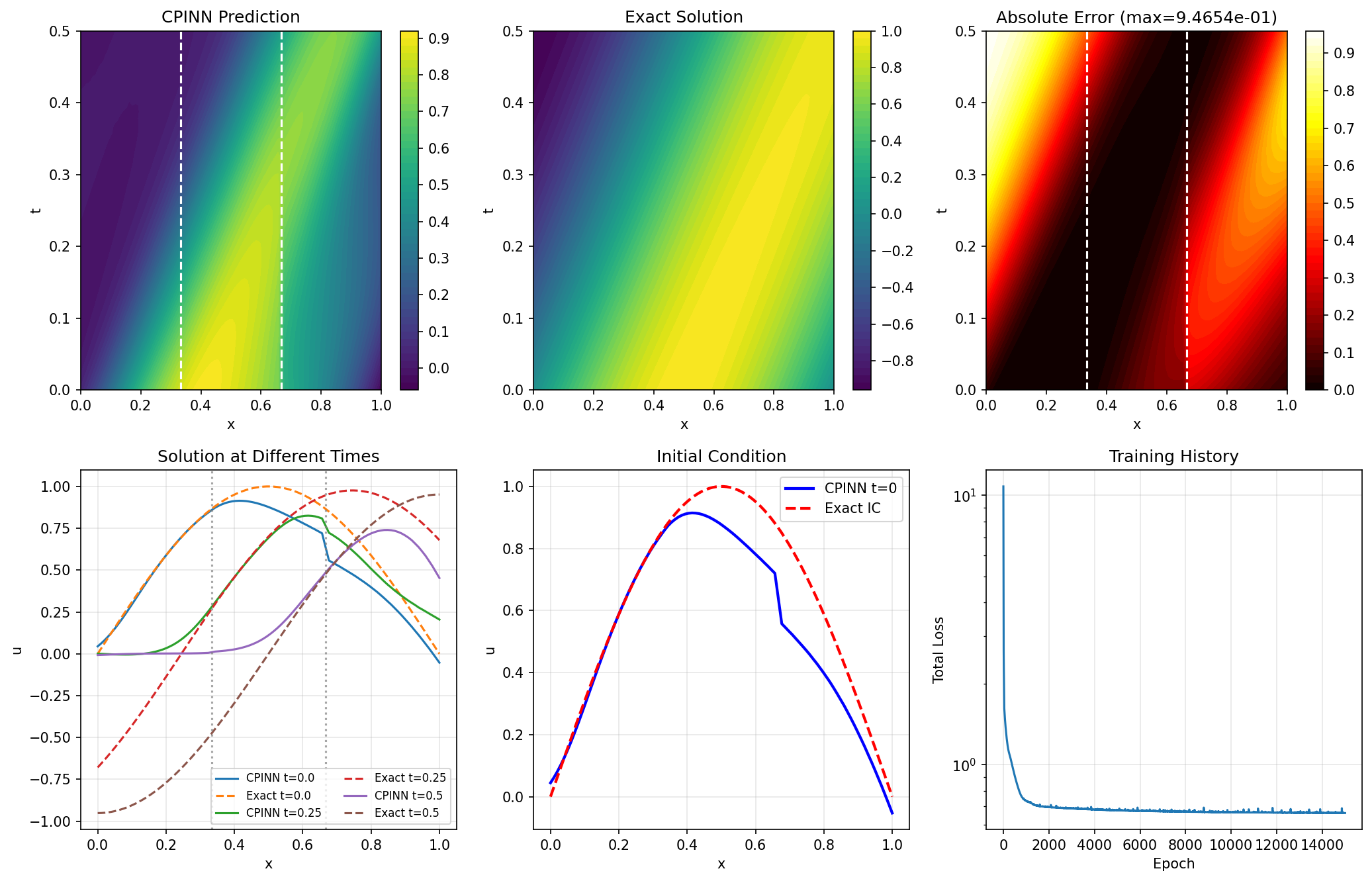
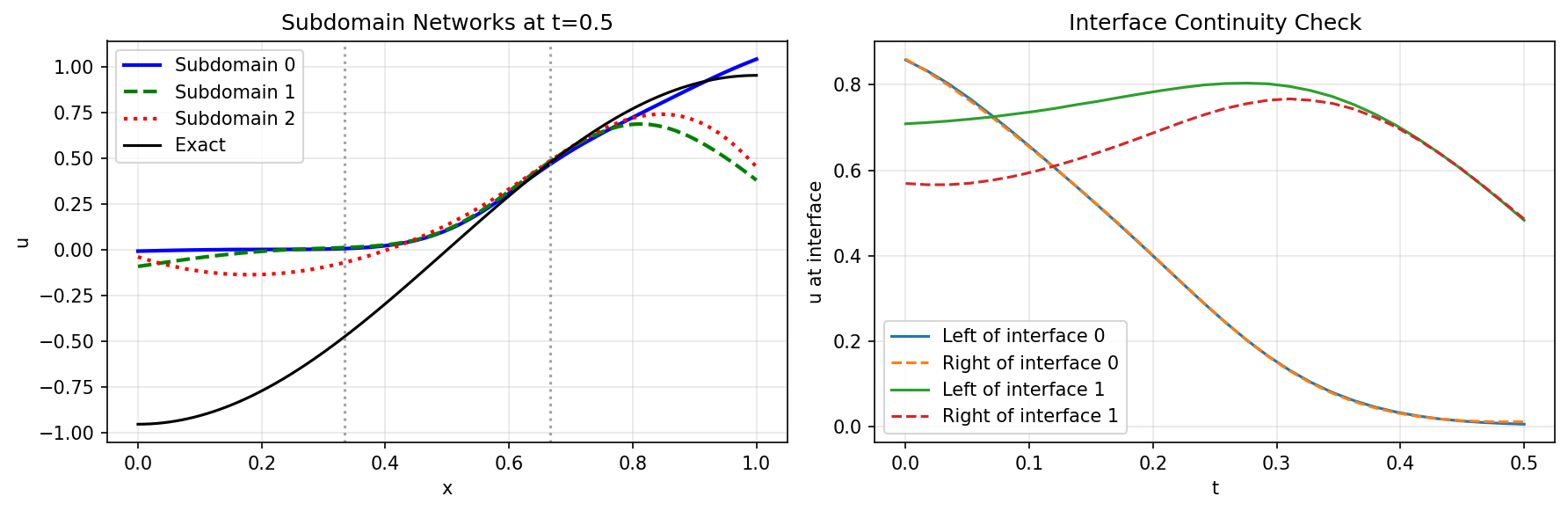
Results Summary
| Metric | Value |
|---|---|
| Final Loss | 2.75e-04 |
| Relative L2 Error | 0.20% |
| Maximum Error | 1.18e-02 |
| Interface 0 Flux Jump | 2.53e-03 |
| Interface 1 Flux Jump | 1.80e-03 |
| Parameters | 3,555 |
| Training Epochs | 15,000 |
The 3-subdomain CPINN matches the manufactured exact solution to 0.2% relative L2 error, with small interface flux jumps (~2e-3) confirming conservation across the subdomain boundaries. (An earlier version imposed homogeneous Dirichlet BCs that were inconsistent with the advecting reference field, which produced a spurious ~50% error; the boundary condition now uses the exact solution's Dirichlet trace.)
Next Steps
Experiments to Try
- Higher diffusion: Try \(D = 0.1\) for better convergence
- More epochs: Train for 50000 epochs
- Larger networks: Use
[64, 64, 64]per subdomain - Fewer subdomains: Try 2 subdomains for simpler case
Related Examples
| Example | Level | What You'll Learn |
|---|---|---|
| FBPINN on Harmonic Oscillator | Intermediate | Overlapping subdomains |
| XPINN on Burgers | Intermediate | Non-overlapping subdomains |
| Advection PINN | Intermediate | Single-domain advection |
API Reference
CPINN: Conservative PINN with flux conservationCPINNConfig: Configuration (continuity, flux, conservation weights)compute_flux_conservation_loss(): Flux conservation at interfacescompute_interface_loss(): Combined interface loss
Troubleshooting
| Issue | Solution |
|---|---|
| High flux jumps | Increase flux_weight significantly |
| Poor accuracy | Use more collocation points |
| Slow convergence | Reduce advection coefficient c |
| Subdomain mismatch | Check subdomain bounds don't overlap |