Navier-Stokes PINN: Kovasznay Flow
| Metadata | Value |
|---|---|
| Level | Advanced |
| Runtime | ~8 min (GPU) / ~30 min (CPU) |
| Prerequisites | JAX, Flax NNX, fluid mechanics |
| Format | Python + Jupyter |
| Memory | ~1 GB RAM |
Overview
This tutorial demonstrates solving the 2D steady incompressible Navier-Stokes equations using a Physics-Informed Neural Network (PINN). The Kovasznay flow is an exact analytical solution to Navier-Stokes, making it an ideal benchmark for validating numerical methods.
The Navier-Stokes equations describe the motion of viscous fluids and are fundamental to computational fluid dynamics. PINNs can solve these equations without mesh generation or explicit discretization, learning the velocity and pressure fields directly from the governing physics.
What You'll Learn
- Implement a PINN for coupled multi-output PDEs (u, v, p)
- Compute mixed derivatives using JAX Jacobian and Hessian
- Enforce continuity and momentum equations simultaneously
- Validate against analytical Kovasznay flow solution
- Visualize velocity vector fields and pressure distributions
Coming from DeepXDE?
If you are familiar with the DeepXDE library:
| DeepXDE | Opifex (JAX) |
|---|---|
dde.geometry.Rectangle(xmin, xmax) |
jax.random.uniform(key, (N, 2)) for (x, y) |
dde.grad.jacobian(u, x, i=0, j=0) |
jax.jacobian(uvp_fn)(xy)[0, 0] for u_x |
dde.grad.hessian(u, x, component=0, i=0) |
jax.hessian(u_fn)(xy)[0, 0] for u_xx |
dde.nn.FNN([2]+[50]*4+[3], "tanh") |
Custom NavierStokesPINN with nnx.Linear |
model.compile("adam", lr=1e-3) |
nnx.Optimizer(pinn, optax.adam(lr), wrt=nnx.Param) |
model.train(iterations=30000) |
Custom training loop with @nnx.jit |
Key differences:
- Multi-output: Network outputs [u, v, p] as a single 3-channel tensor
- Jacobian-based: Use
jax.jacobianfor efficient first derivatives of all outputs - Coupled PDEs: Momentum and continuity equations share the network output
- No L-BFGS: This example uses Adam only; add L-BFGS for better convergence
Files
- Python Script:
examples/pinns/navier_stokes.py - Jupyter Notebook:
examples/pinns/navier_stokes.ipynb
Quick Start
Run the Python Script
Run the Jupyter Notebook
Core Concepts
Navier-Stokes Equations
The 2D steady incompressible Navier-Stokes equations consist of momentum and continuity:
Momentum (x-direction): $\(u \frac{\partial u}{\partial x} + v \frac{\partial u}{\partial y} = -\frac{\partial p}{\partial x} + \frac{1}{Re}\left(\frac{\partial^2 u}{\partial x^2} + \frac{\partial^2 u}{\partial y^2}\right)\)$
Momentum (y-direction): $\(u \frac{\partial v}{\partial x} + v \frac{\partial v}{\partial y} = -\frac{\partial p}{\partial y} + \frac{1}{Re}\left(\frac{\partial^2 v}{\partial x^2} + \frac{\partial^2 v}{\partial y^2}\right)\)$
Continuity: $\(\frac{\partial u}{\partial x} + \frac{\partial v}{\partial y} = 0\)$
Kovasznay Flow
The Kovasznay flow is an exact solution with Re = 20:
| Component | Formula |
|---|---|
| x-velocity | \(u = 1 - e^{\lambda x} \cos(2\pi y)\) |
| y-velocity | \(v = \frac{\lambda}{2\pi} e^{\lambda x} \sin(2\pi y)\) |
| Pressure | \(p = \frac{1}{2}(1 - e^{2\lambda x})\) |
| Lambda | \(\lambda = \frac{1}{2\nu} - \sqrt{\frac{1}{4\nu^2} + 4\pi^2}\) |
Where \(\nu = 1/Re = 0.05\) is the kinematic viscosity.
PINN Architecture
graph TB
    subgraph Input["Collocation Points"]
        A["Domain Points<br/>(x, y) in Ω"]
        B["Boundary Points<br/>(x, y) on ∂Ω"]
    end

    subgraph PINN["Neural Network (x, y) → [u, v, p]"]
        C["Linear + tanh<br/>50 units"]
        D["Linear + tanh<br/>50 units"]
        E["Linear + tanh<br/>50 units"]
        F["Linear + tanh<br/>50 units"]
        G["Linear<br/>3 units"]
    end

    subgraph Loss["Physics-Informed Loss"]
        H["Momentum-x<br/>|u·u_x + v·u_y + p_x - ν∇²u|²"]
        I["Momentum-y<br/>|u·v_x + v·v_y + p_y - ν∇²v|²"]
        J["Continuity<br/>|u_x + v_y|²"]
        K["BC Loss<br/>|u - u_exact|² + |v - v_exact|² + |p - p_exact|²"]
        L["Total Loss"]
    end

    A --> C --> D --> E --> F --> G
    B --> C
    G --> H
    G --> I
    G --> J
    G --> K
    H --> L
    I --> L
    J --> L
    K --> L

    style H fill:#e3f2fd,stroke:#1976d2
    style I fill:#e8f5e9,stroke:#388e3c
    style J fill:#fff3e0,stroke:#f57c00
    style K fill:#fce4ec,stroke:#c2185b
style L fill:#f3e5f5,stroke:#7b1fa2Implementation
Step 1: Imports and Configuration
Terminal Output:
======================================================================
Opifex Example: Navier-Stokes PINN (Kovasznay Flow)
======================================================================
JAX backend: gpu
JAX devices: [CudaDevice(id=0)]
Reynolds number: Re = 20
Domain: x in [-0.5, 1.0], y in [-0.5, 1.5]
Collocation: 2601 domain, 400 boundary
Network: [2] + [50, 50, 50, 50] + [3]
Training: 30000 epochs @ lr=0.001
Step 2: Define Analytical Solution
RE = 20
NU = 1.0 / RE
LAMBDA = 1.0 / (2.0 * NU) - jnp.sqrt(1.0 / (4.0 * NU**2) + 4.0 * jnp.pi**2)

def u_exact(xy):
    x, y = xy[:, 0], xy[:, 1]
    return 1.0 - jnp.exp(LAMBDA * x) * jnp.cos(2.0 * jnp.pi * y)

def v_exact(xy):
    x, y = xy[:, 0], xy[:, 1]
    return LAMBDA / (2.0 * jnp.pi) * jnp.exp(LAMBDA * x) * jnp.sin(2.0 * jnp.pi * y)

def p_exact(xy):
    x = xy[:, 0]
    return 0.5 * (1.0 - jnp.exp(2.0 * LAMBDA * x))
Terminal Output:
Kovasznay Flow: Steady 2D incompressible Navier-Stokes
  Lambda = -1.810099
  u(x,y) = 1 - exp(lambda*x) * cos(2*pi*y)
  v(x,y) = (lambda/2*pi) * exp(lambda*x) * sin(2*pi*y)
  p(x,y) = 0.5 * (1 - exp(2*lambda*x))
Step 3: Create the PINN
class NavierStokesPINN(nnx.Module):
    def __init__(self, hidden_dims: list[int], *, rngs: nnx.Rngs):
        layers = []
        in_features = 2  # (x, y)

        for hidden_dim in hidden_dims:
            layers.append(nnx.Linear(in_features, hidden_dim, rngs=rngs))
            in_features = hidden_dim

        layers.append(nnx.Linear(in_features, 3, rngs=rngs))  # [u, v, p]
        self.layers = nnx.List(layers)

    def __call__(self, xy):
        h = xy
        for layer in self.layers[:-1]:
            h = jnp.tanh(layer(h))
        return self.layers[-1](h)

pinn = NavierStokesPINN(hidden_dims=[50, 50, 50, 50], rngs=nnx.Rngs(42))
Terminal Output:
Step 4: Compute PDE Residuals
def compute_pde_residuals(pinn, xy):
    def uvp_scalar(xy_single):
        return pinn(xy_single.reshape(1, 2)).squeeze()

    def residuals_single(xy_single):
        uvp = uvp_scalar(xy_single)
        u, v = uvp[0], uvp[1]

        # First derivatives via Jacobian
        jac = jax.jacobian(uvp_scalar)(xy_single)
        u_x, u_y = jac[0, 0], jac[0, 1]
        v_x, v_y = jac[1, 0], jac[1, 1]
        p_x, p_y = jac[2, 0], jac[2, 1]

        # Second derivatives (Hessian diagonals)
        hess_u = jax.hessian(lambda xy: uvp_scalar(xy)[0])(xy_single)
        hess_v = jax.hessian(lambda xy: uvp_scalar(xy)[1])(xy_single)

        u_xx, u_yy = hess_u[0, 0], hess_u[1, 1]
        v_xx, v_yy = hess_v[0, 0], hess_v[1, 1]

        # Momentum equations
        momentum_x = u * u_x + v * u_y + p_x - (1/RE) * (u_xx + u_yy)
        momentum_y = u * v_x + v * v_y + p_y - (1/RE) * (v_xx + v_yy)

        # Continuity
        continuity = u_x + v_y

        return jnp.array([momentum_x, momentum_y, continuity])

    return jax.vmap(residuals_single)(xy)
Step 5: Training
Terminal Output:
Training PINN...
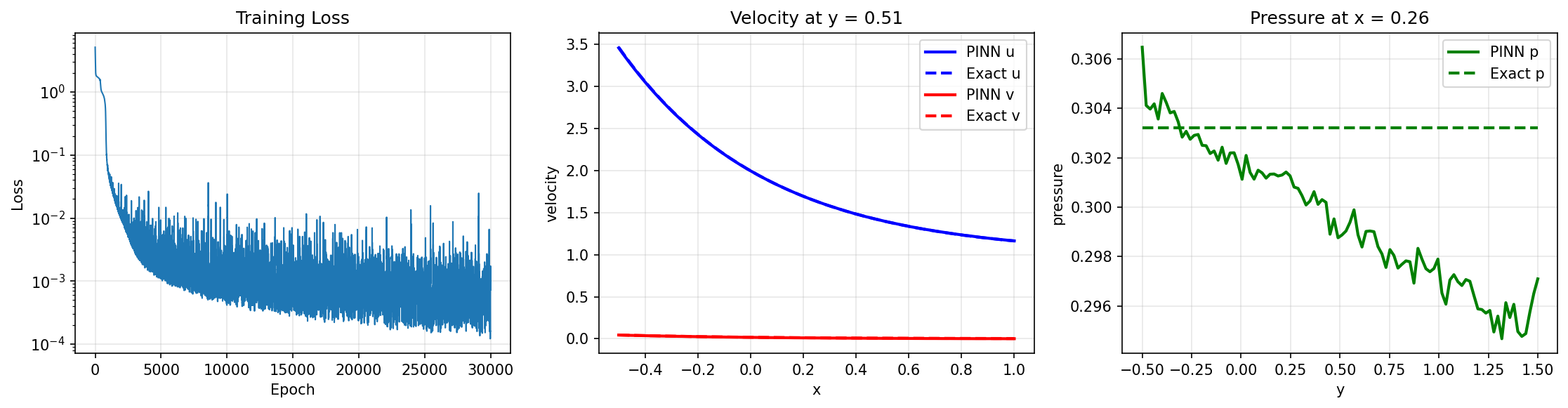
  Epoch     1/30000: loss=5.135920e+00
  Epoch  5000/30000: loss=1.756912e-03
  Epoch 10000/30000: loss=4.721234e-04
  Epoch 15000/30000: loss=1.124221e-03
  Epoch 20000/30000: loss=2.046824e-03
  Epoch 25000/30000: loss=1.094199e-03
  Epoch 30000/30000: loss=7.266006e-04
Final loss: 7.266006e-04
Step 6: Evaluation
Terminal Output:
Evaluating PINN...
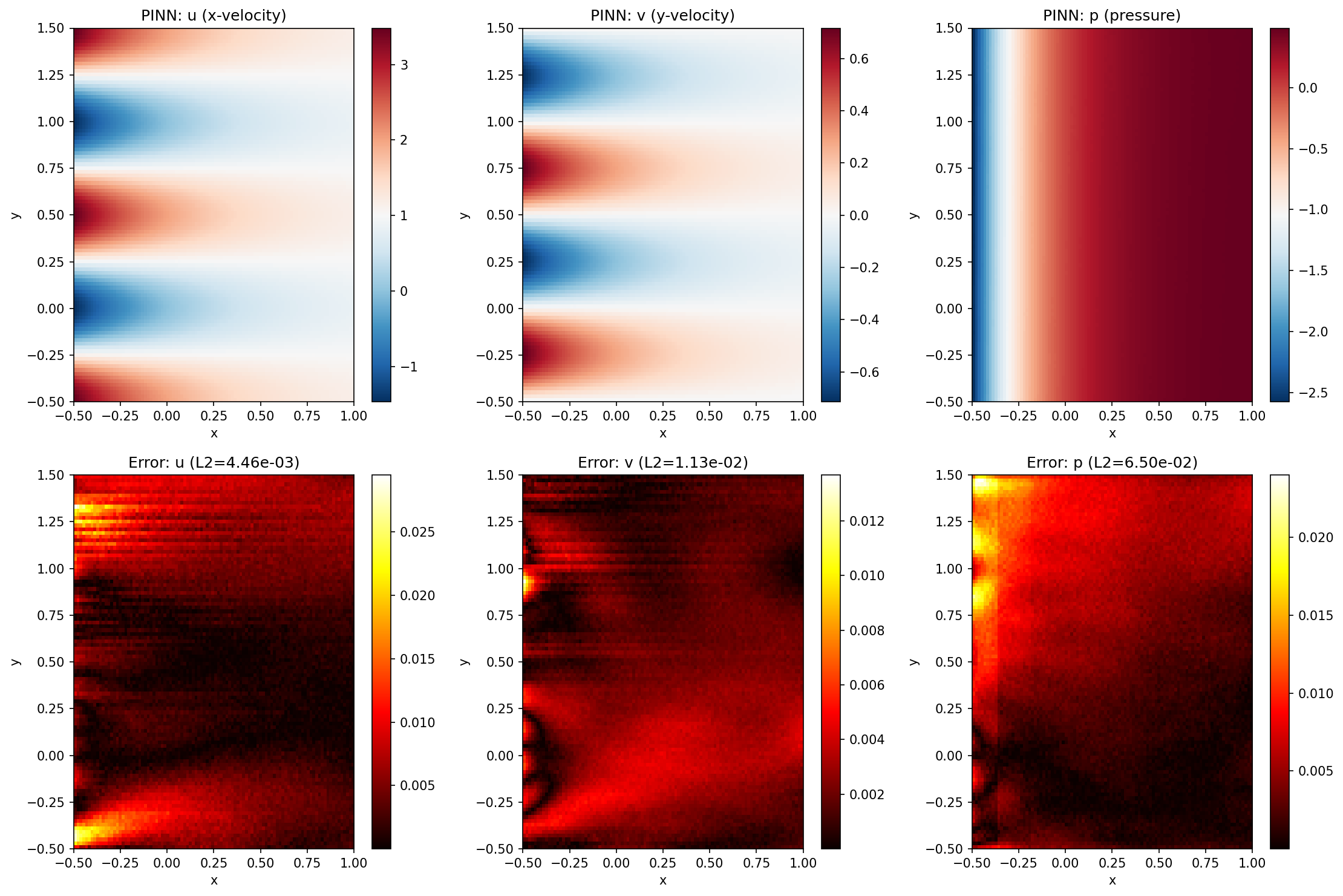
L2 relative error (u): 4.457689e-03
L2 relative error (v): 1.126896e-02
L2 relative error (p): 6.496343e-02
Mean PDE residual:     8.192191e-03
Visualization
Solution Fields and Errors
Training and Cross-Sections
Results Summary
| Metric | Value |
|---|---|
| Final Loss | 7.27e-04 |
| L2 Error (u) | 0.45% |
| L2 Error (v) | 1.13% |
| L2 Error (p) | 6.50% |
| Mean PDE Residual | 8.19e-03 |
| Parameters | 7,953 |
| Training Epochs | 30,000 |
Next Steps
Experiments to Try
- Add L-BFGS: Use
optax.lbfgsfor second-order refinement - Higher Re: Try Re = 100 or 400 for more challenging flows
- More epochs: Train for 50,000+ epochs for better pressure accuracy
- Deeper network: Try
hidden_dims=[100, 100, 100, 100, 100] - Loss weighting: Balance momentum vs continuity losses
Related Examples
| Example | Level | What You'll Learn |
|---|---|---|
| Poisson Equation | Intermediate | Simpler elliptic PDE |
| Burgers Equation | Intermediate | Nonlinear convection |
| FNO on Darcy Flow | Intermediate | Data-driven alternative |
| PINO on Burgers | Advanced | Hybrid approach |
API Reference
nnx.Linear- Linear layernnx.Optimizer- Optimizer wrapperjax.jacobian- Jacobian computationjax.hessian- Hessian computation
Troubleshooting
Pressure error much higher than velocity
Symptom: L2 error in p is 5-10x higher than u, v errors.
Cause: Pressure is determined only indirectly through momentum gradients.
Solution: Add pressure reference point constraint or increase BC weighting:
# Fix pressure at a point (e.g., outflow corner)
def pressure_reference_loss(pinn):
    ref_point = jnp.array([[X_MAX, Y_MIN]])
    p_pred = pinn(ref_point)[0, 2]
    p_exact_val = p_exact(ref_point)[0]
    return (p_pred - p_exact_val) ** 2
Loss oscillates without converging
Symptom: Loss fluctuates around a value without steady decrease.
Cause: Adam stuck in saddle point or local minimum.
Solution: Add learning rate scheduling or use L-BFGS refinement:
# Learning rate schedule
schedule = optax.exponential_decay(
    init_value=1e-3,
    transition_steps=10000,
    decay_rate=0.5
)
opt = nnx.Optimizer(pinn, optax.adam(schedule), wrt=nnx.Param)
Continuity not satisfied
Symptom: Large continuity residual even with small momentum residual.
Cause: Network not enforcing divergence-free constraint.
Solution: Increase continuity loss weight or use stream function formulation:
# Higher weight for continuity
def total_loss(pinn, xy_dom, xy_bc, u_bc, v_bc, p_bc):
    mom_x, mom_y, cont = compute_pde_residuals(pinn, xy_dom)
    loss_pde = jnp.mean(mom_x**2) + jnp.mean(mom_y**2) + 10.0 * jnp.mean(cont**2)
    # ... boundary loss
    return loss_pde + loss_bc
Slow training
Symptom: Each epoch takes >1 second on GPU.
Cause: Hessian computation is expensive for multi-output networks.
Solution: Enable gradient checkpointing via TrainingConfig, or split Hessian computation: